BMR vs MFR: What's the Difference? (With Examples)
2026-07-01
BMR vs MFR explained — full forms, what each contains, who prepares them, and how the Master Formula Record becomes the Batch Manufacturing Record, with an example.
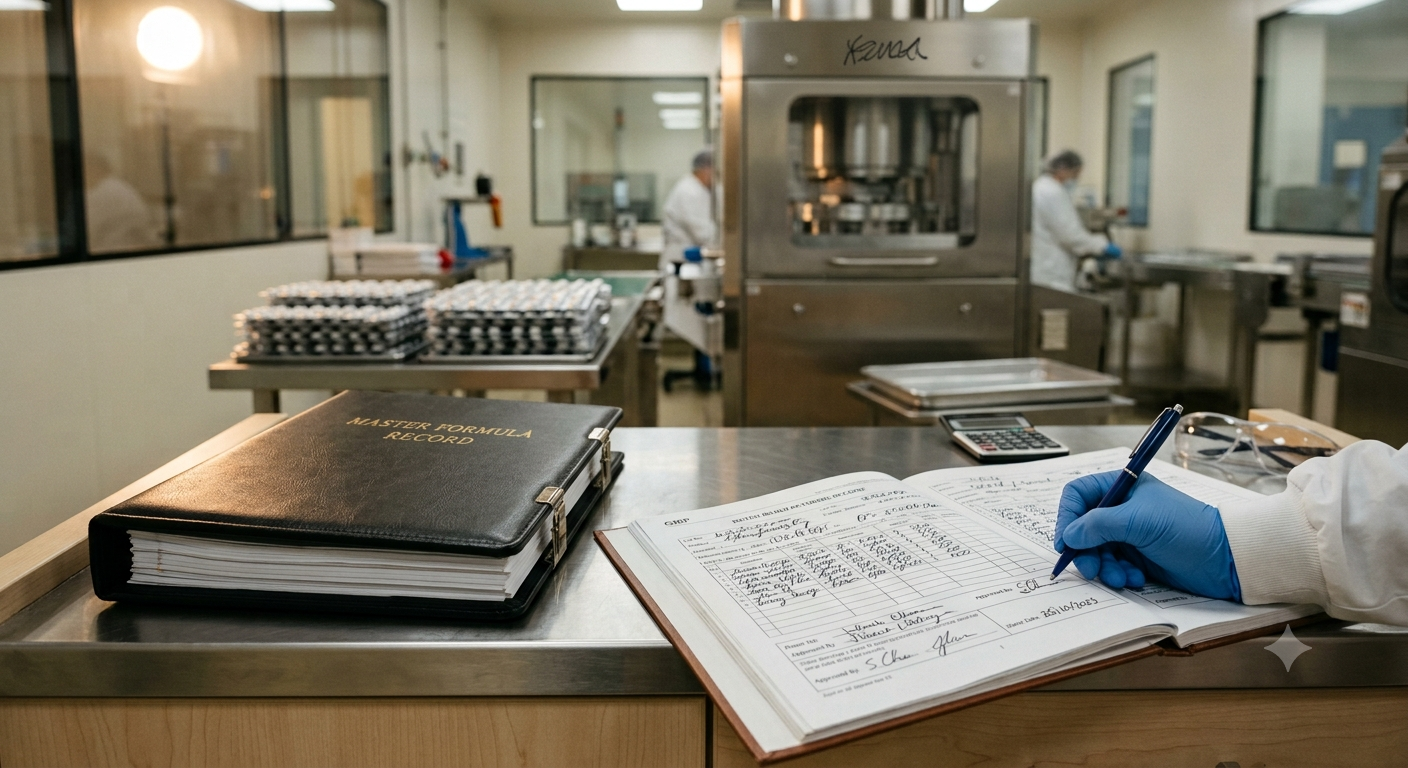
If you work in pharma manufacturing or QA, you've seen both terms — often used loosely, sometimes as if they mean the same thing. They don't, and mixing them up is a classic audit finding.
The MFR (Master Formula Record) is the approved recipe for a product. The BMR (Batch Manufacturing Record) is the filled-in proof of one specific batch made from that recipe. One is the master template; the other is the executed evidence. Here's the full picture.
Full forms
- MFR — Master Formula Record (the US FDA equivalent is the Master Production and Control Record, or MPR)
- BMR — Batch Manufacturing Record (closely related to the Batch Production Record, BPR)
The simplest analogy
Think of a kitchen:
- The MFR is the recipe card — written and approved once, kept as the reference. It lists the exact ingredients, quantities, method, and what the finished dish should look like.
- The BMR is the cooking log for one specific bake — a fresh copy of the recipe with the actual weights you used, the oven you used, the time you started, who cooked it, and how it turned out.
You write the recipe once. You fill in a new log every single time you cook.
The difference, point by point
- What it is — MFR: the master, approved formula and process for a product. BMR: the record of one actual batch made from that MFR.
- Purpose — MFR: the reference, how the product should be made. BMR: the evidence, how a specific batch was made.
- How many — MFR: one per product/strength (revised via change control). BMR: one per batch.
- What it contains — MFR: standard quantities, process steps, in-process specs, equipment class, packaging. BMR: actual quantities, actual equipment IDs, dates and times, in-process results, operator and QA signatures.
- When it's created — MFR: once, at development or tech transfer. BMR: issued fresh for every batch, from the current MFR.
- Who fills it — MFR: prepared by production/R&D, approved by QA. BMR: executed by operators on the floor, reviewed by QA.
- Can it change? — MFR: only through formal change control. BMR: no — it's a contemporaneous record of what happened.
- Regulatory reference — MFR: 21 CFR 211.186; WHO / Schedule M master formula. BMR: 21 CFR 211.188 (Batch Production & Control Records).
How they connect
1. The MFR is authored for a product during development or tech transfer — formula, process, in-process checks, expected yields, packaging. QA approves it, and it becomes the single source of truth.
2. For each batch, QA issues a BMR — a controlled copy of the MFR with blank fields for the actuals.
3. Operators execute the batch, recording actual dispensed quantities, equipment used, process parameters, timings and in-process results — signing each step.
4. QA reviews the completed BMR against the MFR before batch release. Any gap is investigated as a deviation.
So the MFR flows into every BMR. Change the MFR (through change control) and all future BMRs reflect the new version.
A worked example
Say you make Paracetamol 500 mg tablets:
- The MFR states: per 100,000 tablets — 50.00 kg paracetamol, 8.00 kg starch, granulate under set parameters, compress to a target weight of 550 mg ± 5%, target hardness in range.
- For Batch B-2407, the BMR records: actually dispensed 50.02 kg paracetamol (AR No. …), granulated in FBD-03 on 04-Jul, compression started 10:20, average tablet weight 551 mg, hardness within spec, yield 98.6% — signed by the operator and verified by QA.
The MFR said what to do. The BMR proves what was done — for that one batch.
Why the difference matters
- Auditors expect every BMR to match the current approved MFR version. A BMR issued from an outdated MFR is a finding.
- The BMR is your legal, contemporaneous record — it must be complete, attributable and signed (ALCOA+). The MFR is your controlled master — it must be version- and change-controlled.
- Treating them as one document — editing "the master" per batch — breaks both traceability and data integrity.
Common mistakes
- Using "BMR" and "MFR" interchangeably in SOPs and training.
- Issuing BMRs from an old MFR version after a change was approved.
- Uncontrolled MFR revisions — no change control, no version history.
- Incomplete BMRs — missing signatures, blank fields, back-dated entries.
From paper to a controlled digital record
The hard part is rarely the concept — it's the control. Paper MFRs get photocopied; BMRs go missing in production; the "current version" becomes anyone's guess; and QA loses days reconciling records before release.
A workflow system fixes this by making the MFR a versioned master and auto-issuing a fresh, sequential BMR for each batch — every field, signature and timestamp captured, and the batch un-releasable until its BMR is complete and QA-reviewed. That is exactly how Flobri handles batch records and release.
Frequently Asked Questions
Is MFR the same as MPR?
Broadly, yes. "Master Formula Record" is the WHO / Schedule-M term; the US FDA calls it the Master Production and Control Record (MPR). Same idea — the approved master.
Is BMR the same as BPR?
Very close. BMR = Batch Manufacturing Record, BPR = Batch Production Record. Some firms split manufacturing (BMR) and packing (BPR); the FDA's umbrella term is the Batch Production and Control Record.
Who prepares the MFR?
Usually R&D or production, approved by QA. One per product/strength.
Who fills in the BMR?
Production operators on the floor, reviewed by QA before release. One per batch.
Which one supports batch release?
The completed BMR — reviewed against the MFR — is what supports release of that batch.