CAPA Process in Pharma — How to Build a Corrective Action Workflow
2026-05-06
Build a complete CAPA workflow for pharmaceutical companies — from issue initiation to effectiveness verification with audit-ready documentation.
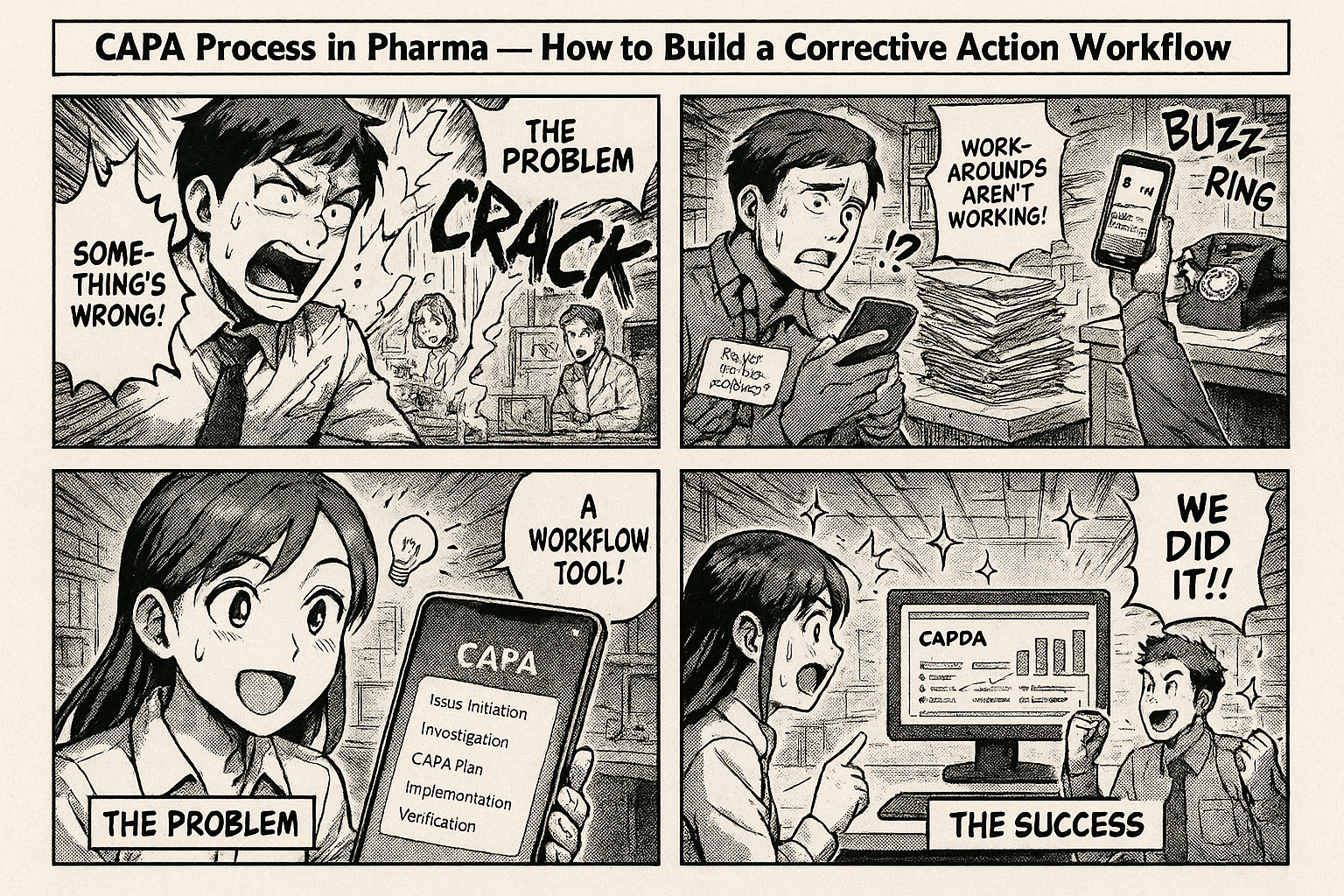
A quality deviation happens. A batch fails. A customer complains. What comes next determines whether the problem gets fixed or just gets documented.
CAPA — Corrective and Preventive Action — is the process that turns quality failures into permanent fixes. When done right, it prevents the same problem from happening again. When done wrong (or on paper), it becomes a compliance checkbox that nobody follows up on.
What CAPA Covers
Corrective Action
Fix the immediate problem:
- What went wrong?
- What is the root cause?
- What action was taken to fix it?
- Was the fix effective?
Preventive Action
Stop it from happening again:
- What systemic change is needed?
- What process, training, or equipment needs updating?
- How will we verify the change worked?
The CAPA Workflow Stages
Stage 1: Initiation
Who: Anyone who identifies a quality issue (QC, production, customer service)
What they document:
- Description of the issue
- Where and when it was discovered
- Affected batches/products
- Severity (Critical / Major / Minor)
- Related deviation or complaint number
Stage 2: Investigation
Who: QA team / designated investigator
What they do:
- Root cause analysis (5-Why, fishbone diagram)
- Impact assessment — what else could be affected?
- Review of similar past CAPAs
- Evidence collection
What they document:
- Root cause statement
- Investigation findings
- Risk assessment
Stage 3: Action Plan
Who: QA manager + department heads
What they define:
- Corrective actions with deadlines and responsible persons
- Preventive actions with deadlines and responsible persons
- Required changes to SOPs, training, or equipment
Stage 4: Implementation
Who: Assigned action owners
What they do:
- Execute each action item
- Document what was done
- Collect evidence of implementation
Stage 5: Effectiveness Check
Who: QA team
What they verify:
- Did the corrective action fix the immediate problem?
- Has the preventive action prevented recurrence?
- Review period: 30/60/90 days after implementation
- If not effective → re-open and revise
Stage 6: Closure
Who: QA Head / Authorized person
What they do:
- Review all evidence
- Confirm effectiveness
- Close the CAPA
- Update quality metrics
Why Paper CAPA Fails
No Follow-Up
Action items are assigned in a meeting. Three weeks later, nobody checks if they were done. The CAPA file sits in a cabinet "pending implementation."
No Traceability
An auditor asks: "Show me all CAPAs related to packaging defects in the last year." That requires manually searching through files. Good luck finishing before the auditor leaves.
No Effectiveness Tracking
The whole point of CAPA is to prevent recurrence. But if you can't easily check "has this type of issue happened again since the CAPA was closed?" — you don't know if it worked.
No Escalation
A critical CAPA sits uninvestigated for 2 weeks. Nobody notices because it's in a register, not on a dashboard.
The Digital CAPA Workflow
In Flobri, describe your CAPA process:
"Quality issue is reported with description, severity, and affected batch. QA investigates and documents root cause. Action plan is created with corrective and preventive actions assigned to specific people with deadlines. Each action owner marks completion. QA verifies effectiveness after 30 days. QA Head reviews and closes."
Flobri generates the complete workflow with:
- Stages matching your process
- Form fields for root cause, actions, evidence
- Assignment routing to the right people
- Deadline tracking with overdue alerts
- Dashboard showing open CAPAs, overdue investigations, pending effectiveness checks
What the Dashboard Shows
- Open CAPAs by stage — how many are in investigation, action plan, implementation, effectiveness check
- Overdue CAPAs — investigations pending >7 days, actions past deadline
- CAPA by category — packaging, contamination, equipment, process deviation
- Effectiveness rate — how many closed CAPAs had confirmed effectiveness
- Trend — are CAPAs increasing or decreasing over time?
Try It
Go to insights.flobri.com/build and describe your CAPA process. Get a working workflow with audit trails in under 10 minutes.
Flobri digitizes CAPA processes with structured workflows, root cause documentation, action tracking, effectiveness verification, and audit-ready records — compliant with GMP requirements.