How to Implement Change Control in Pharma Manufacturing
2026-05-13
Manage changes to processes, equipment, materials, and documents with a structured change control workflow — impact assessment, approval routing, and implementation tracking.
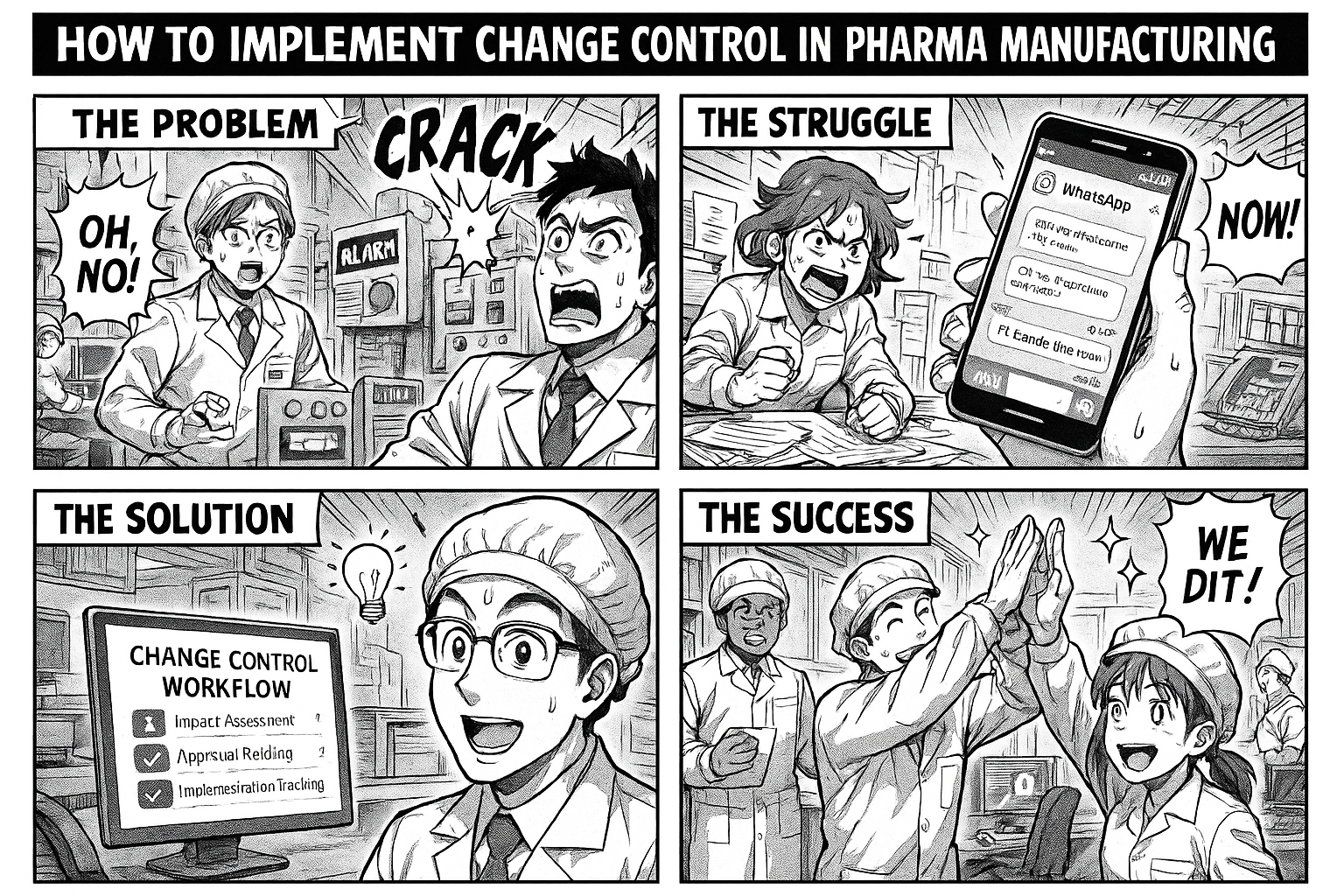
You want to change the supplier of a raw material. Or modify a process parameter. Or update a cleaning procedure. In pharma, you can't just make the change — you need a formal change control process.
Change control ensures that every change is evaluated for impact, approved by the right people, implemented correctly, and documented completely.
Types of Changes
Process Changes
- Modifying manufacturing parameters (temperature, time, speed)
- Changing batch size
- Altering process steps
Material Changes
- New raw material supplier
- Different grade of excipient
- Alternative packaging material
Equipment Changes
- New equipment installation
- Equipment modification
- Change in equipment qualification status
Document Changes
- SOP revision
- Specification update
- Master formula revision
Facility Changes
- HVAC modification
- Layout change
- Utility system changes
The Change Control Workflow
Stage 1: Change Request
Who: Anyone who identifies the need for a change
What they document:
- What needs to change and why
- Current state vs proposed state
- Urgency: Planned / Urgent / Emergency
- Category: Process / Material / Equipment / Document / Facility
- Affected products, departments, documents
Stage 2: Impact Assessment
Who: Cross-functional team (QA, Production, QC, Regulatory)
What they evaluate:
- Impact on product quality
- Impact on validated processes
- Regulatory implications (does this need a variation filing?)
- Risk assessment (what could go wrong?)
- Required validation/qualification activities
- Training requirements
- Documents that need revision
Stage 3: Approval
Who: Based on impact level
- Minor change: Department head + QA
- Major change: Plant head + QA head + Regulatory
- Critical change: Management + Regulatory + QA head
Stage 4: Implementation
Who: Assigned action owners
What they do:
- Execute the change as approved
- Update affected documents (SOPs, specifications)
- Complete required validation/qualification
- Conduct training
- Document evidence of implementation
Stage 5: Effectiveness Review
Who: QA
What they verify:
- Was the change implemented as planned?
- Were all documents updated?
- Was training completed?
- Is the change producing the expected result?
- Any unintended consequences?
Stage 6: Closure
Change control closed with complete documentation.
Why Paper Change Control Fails
1. Slow Approvals
The change request form travels between 5 desks. It sits on each desk for days. A planned change that should take 2 weeks takes 2 months.
2. Incomplete Impact Assessment
The form has a small box for impact assessment. People write "No impact" because the box is too small for detail. The real impact is discovered during implementation — too late.
3. Lost Implementation Tasks
The change was approved with 8 action items. Three months later, 3 items are still not done. Nobody tracked them.
4. No Trend Analysis
How many changes were raised this year? How many were process vs material? What's the average closure time? These questions require manually counting entries in a register.
What the Dashboard Shows
- Open change controls by status (pending assessment, pending approval, in implementation)
- Overdue implementations
- Changes by category and department
- Average time from request to closure
- Changes requiring regulatory filing
Set It Up
Go to insights.flobri.com/build and describe:
"Anyone raises a change request with description, category, urgency, and affected areas. Cross-functional team does impact assessment. Approval based on impact level. Action owners implement changes and update documents. QA verifies effectiveness. Change control closed."
Flobri manages change control — from request to closure — with impact assessment, multi-level approval routing, implementation tracking, and effectiveness verification for GMP compliance.