Deviation Management in Pharma: The Complete GMP Guide
2026-05-12
What deviation management means in pharma manufacturing — deviation types, the full process flow from detection to CAPA closure, root cause analysis, and GMP audit requirements.
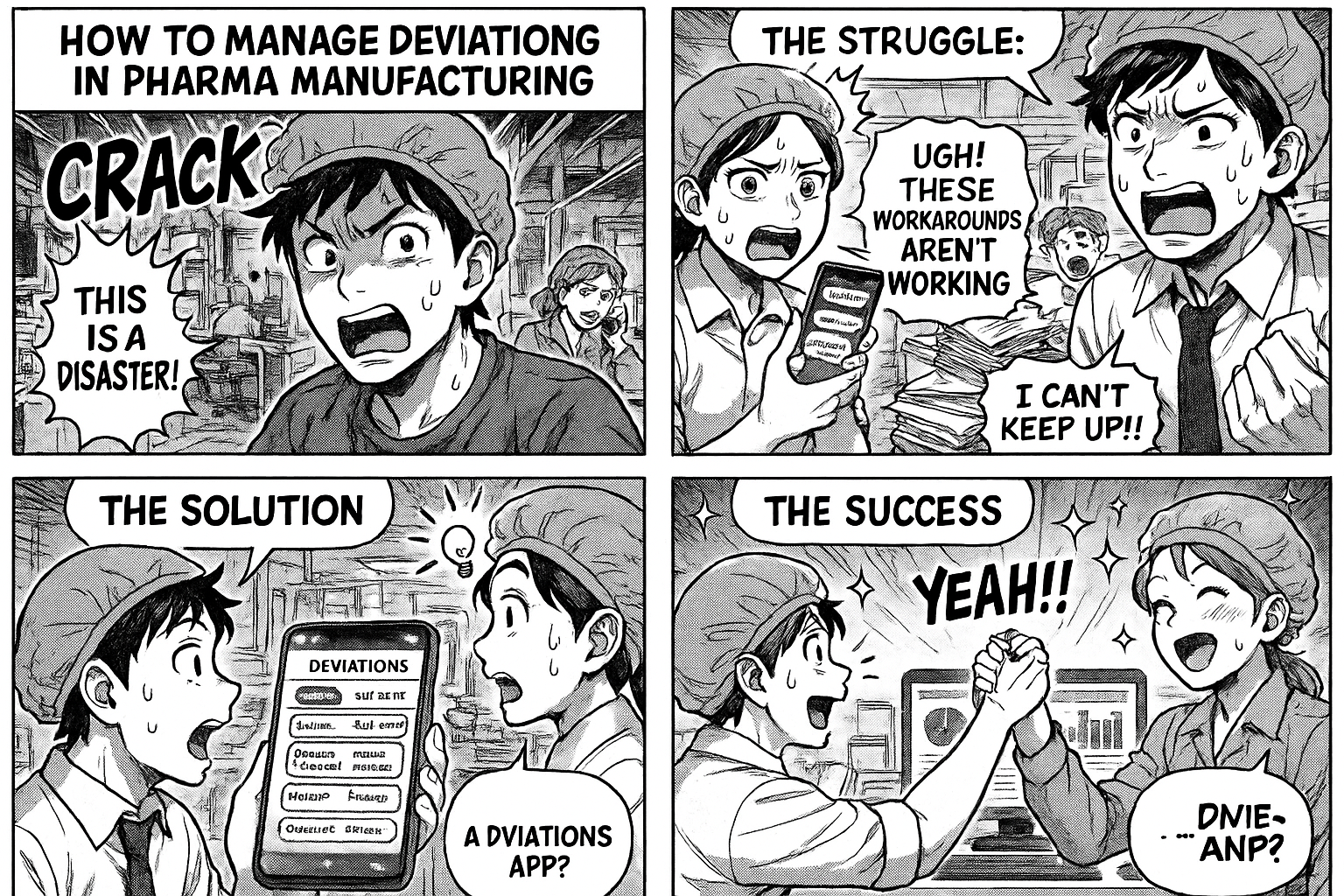
A deviation is any departure from an approved procedure, process, specification, or standard. In pharma manufacturing, every deviation must be documented, investigated, and resolved — not to satisfy an auditor, but because patient safety depends on it. Deviation management is the system that makes sure none of them slip through the cracks.
This guide covers what deviation management is, how deviations are classified, the full process flow from detection to closure, how root cause analysis and CAPA fit in, and what to look for in a deviation management system.
What Is Deviation Management?
Deviation management is the structured process pharma and other GMP-regulated manufacturers use to capture, classify, investigate, and close out any departure from an approved standard. A complete deviation management process answers four questions for every event:
- What happened, and how bad is it? (detection and classification)
- Why did it happen? (root cause analysis)
- What are we doing about it? (corrective and preventive action — CAPA)
- Did the fix work? (effectiveness verification and closure)
Done well, it does more than close individual events — it surfaces patterns across events so you can stop problems before they recur. Done on paper, it becomes a register of 200 entries that nobody can analyze.
What Counts as a Deviation?
Common deviations in pharma manufacturing include:
- Temperature excursion in cold storage
- Equipment malfunction during production
- Wrong material dispensed
- Yield outside acceptable range
- Environmental monitoring failure
- Process parameter out of specification
- Documentation error
- Cleaning validation failure
These are process deviations — unplanned departures from how the process should have run. (A planned, pre-approved departure is handled through change control, not the deviation process.)
Types of Deviations: Minor, Major, and Critical
Classifying severity drives everything downstream — who investigates, how fast, and whether the batch is held. Most GMP systems use three tiers:
- Minor: No impact on product quality, safety, or efficacy. A small documentation error, for example. Investigated, but routine.
- Major: Potential impact on quality, or a repeated minor deviation that signals a systemic issue. Requires formal investigation and CAPA.
- Critical: Direct impact on product quality, patient safety, or regulatory compliance — a temperature excursion affecting released batches, for instance. Triggers immediate batch quarantine and senior QA involvement.
The classification is rarely final at first sight. A "minor" event that turns out to affect three batches becomes critical the moment the investigation reveals the true impact — which is why severity should be re-evaluated, not locked at reporting.
The Deviation Process Flow, Step by Step
Here is the deviation process flow as a structured workflow, from the moment something goes wrong to formal closure.
Stage 1: Detection & Reporting
Who: Anyone who discovers the deviation
What they record:
- Date and time of detection
- Location (department, area, equipment)
- Description of what happened
- Immediate action taken
- Category: Critical / Major / Minor
- Affected batches/products
Auto-routed to: QA for review
Stage 2: QA Initial Review
Who: QA officer
What they do:
- Verify the deviation is valid
- Classify severity (if not already done)
- Determine if the batch needs to be quarantined
- Assign an investigator
- Set the investigation deadline
Stage 3: Investigation
Who: Assigned investigator (production, QC, or engineering)
What they document:
- Root cause analysis (5-Why, Fishbone)
- Impact assessment — what else could be affected?
- Similar past deviations reviewed
- Evidence collected (photos, data, logs)
- Root cause conclusion
Stage 4: CAPA
Who: QA + department heads
What they define:
- Corrective actions (fix the immediate issue)
- Preventive actions (stop recurrence)
- Responsible persons and deadlines
- Changes to SOPs, training, or equipment needed
Stage 5: QA Head Approval
Who: QA Head / Authorized person
What they do:
- Review investigation adequacy
- Approve or reject the proposed CAPA
- Decide on batch disposition (release, reject, reprocess)
Stage 6: CAPA Implementation Verification
Who: QA
What they verify:
- Were corrective actions completed?
- Were preventive actions implemented?
- Is there evidence of effectiveness?
Stage 7: Closure
The deviation is closed with all documentation complete and the full trail intact.
Root Cause Analysis: Getting to the Real Why
The single biggest reason deviations recur is that investigations stop at the symptom. "Operator error" is not a root cause — it's where a lazy investigation ends. Two structured techniques keep investigations honest:
- 5-Why: Ask "why" repeatedly until you reach a cause you can actually act on. "The batch failed → because the temperature drifted → because the chiller cut out → because maintenance was overdue → because there was no calibration reminder." The fix isn't "retrain the operator" — it's a calibration tracking system.
- Fishbone (Ishikawa): Map possible causes across categories — people, process, equipment, materials, environment, measurement. Useful when the cause isn't a single chain.
A good deviation management system forces the investigator to record the analysis, not just the conclusion — so an auditor (and your future self) can see how you got to the root cause.
Why the Paper Deviation Process Fails
The typical paper process: someone notices something wrong, writes it on a form, the form goes to QA, QA logs it in a register, investigation happens eventually, CAPA is raised sometimes, the deviation closes weeks later. Four failure modes follow:
1. Late Reporting
The deviation happened on Monday and was reported on Wednesday. The investigation can't determine root cause because conditions have already changed.
2. Lost in the Register
QA has a register with 200 entries, 40 still open. Which are critical? Which are overdue? The register doesn't tell you.
3. No Trend Analysis
The same deviation has happened five times this quarter. Nobody noticed, because each was a separate paper entry. The trend only surfaces at annual review — nine months too late.
4. CAPA Disconnected
A deviation leads to a CAPA, but the CAPA lives in a different register. When the auditor asks "show me the CAPA linked to Deviation #47," someone cross-references two registers by hand.
Deviation Management Software: What to Look For
If you're evaluating a deviation management system, the features that actually matter in a GMP setting:
- Floor-level reporting: A mobile-friendly form so deviations are logged the moment they're found, not days later.
- Automatic routing and escalation: Each deviation routes to the right reviewer, and overdue investigations surface automatically on the QA head's dashboard instead of going quiet.
- Built-in severity classification: Minor / major / critical, re-evaluable as the investigation develops.
- Linked CAPA: Every deviation connects to its CAPA in the same system and the same audit trail — no second register.
- Trend analysis: The system flags recurrence ("5 temperature excursions in Area B this quarter") without anyone manually tallying.
- Audit-ready trail: A complete, timestamped record from detection to closure, exportable for FDA / WHO / CDSCO inspection.
You don't necessarily need a heavyweight, six-month QMS implementation to get this. A configurable workflow platform can give you the same structure in days. For a deeper evaluation, see our deviation management software buyer's guide.
Deviation Management Dashboard & Trend Analysis
The point of going digital is the view you get across all deviations.
KPIs
- Open deviations (total, by severity)
- Overdue investigations (>15 days without root cause)
- Average closure time
- Deviations this month vs. last month
Trend Analysis
- Deviations by department — where are most issues?
- Deviations by category — what types recur?
- Deviations by equipment — which machines cause problems?
- Monthly trend — increasing or decreasing?
Audit Readiness
- Click any deviation to see the full trail from detection to closure
- Filter by date range, department, severity, status
- Export as PDF for regulatory submission
Deviation, CAPA, and Change Control: How They Connect
Deviation management doesn't live alone. It sits inside a small family of GMP processes:
- Deviation → CAPA: Every significant deviation should produce a CAPA. The CAPA is where prevention actually happens; the deviation is just the trigger.
- Deviation → Change Control: If the fix means changing an SOP, a piece of equipment, or a material, that change runs through change control so it's assessed and approved before implementation.
- Deviation → Batch Disposition: When a deviation affects a specific batch, its resolution feeds directly into the batch release decision — release, reject, or reprocess.
When these three share one system and one audit trail, an auditor can trace any event end to end. When they live in three separate registers, every inspection becomes a manual cross-referencing exercise.
Set It Up
Go to insights.flobri.com/build and describe the process in plain English:
"Anyone reports a quality deviation with description, severity, affected batches, and immediate action. QA reviews and assigns an investigator. The investigator documents root cause analysis. CAPA is defined with corrective and preventive actions. QA head approves. CAPA implementation is verified. Deviation closed."
The platform builds the workflow, the forms, the routing, and the dashboard from that description — no IT project required.
Frequently Asked Questions
What is a deviation in pharma?
A deviation is any unplanned departure from an approved procedure, process, specification, or standard during manufacturing, testing, packaging, or storage. It must be documented and investigated under GMP.
What is the difference between a deviation and a change control?
A deviation is unplanned — something went wrong against the approved standard. A change control is planned — a deliberate, pre-approved change to a process, document, or equipment. Deviations are reactive; change controls are proactive.
What are the types of deviations?
Deviations are typically classified as minor, major, or critical, based on their potential impact on product quality, patient safety, and regulatory compliance. Severity can be re-evaluated as an investigation reveals the true impact.
What is the deviation management process?
The process flows through detection and reporting, QA review and classification, investigation and root cause analysis, CAPA definition, QA head approval, CAPA verification, and closure — each step documented with a timestamped audit trail.
What should a deviation report include?
At minimum: date/time and location of detection, a clear description of what happened, immediate action taken, severity classification, affected batches or products, the root cause conclusion, and the linked CAPA.
Do I need dedicated deviation management software?
Not necessarily a heavyweight QMS. What you need is floor-level reporting, automatic routing and escalation, linked CAPA, trend analysis, and an audit-ready trail. A configurable workflow platform can deliver all of that without a long implementation.
Flobri digitizes deviation management — from detection to closure — with root cause tracking, CAPA linkage, trend analysis, and audit-ready documentation for GMP compliance. Build your deviation workflow in minutes.
Related guides
- Pharmaceutical Quality Management System (QMS): The Complete Guide
- Batch Release, Deviation & OOS Workflow: Data Fields & Status Model (GMP)
- OOS Investigation: Step-by-Step FDA Phase I & II Flowchart
- CAPA Process in Pharma — How to Build a Corrective Action Workflow
- Deviation Management Software: Buyer's Guide & GMP Checklist