How to Track Pending Work Across Your Team Without Daily Meetings
2026-05-03
Daily status meetings waste 4 hours per week. Replace them with a dashboard that shows pending work in real time.
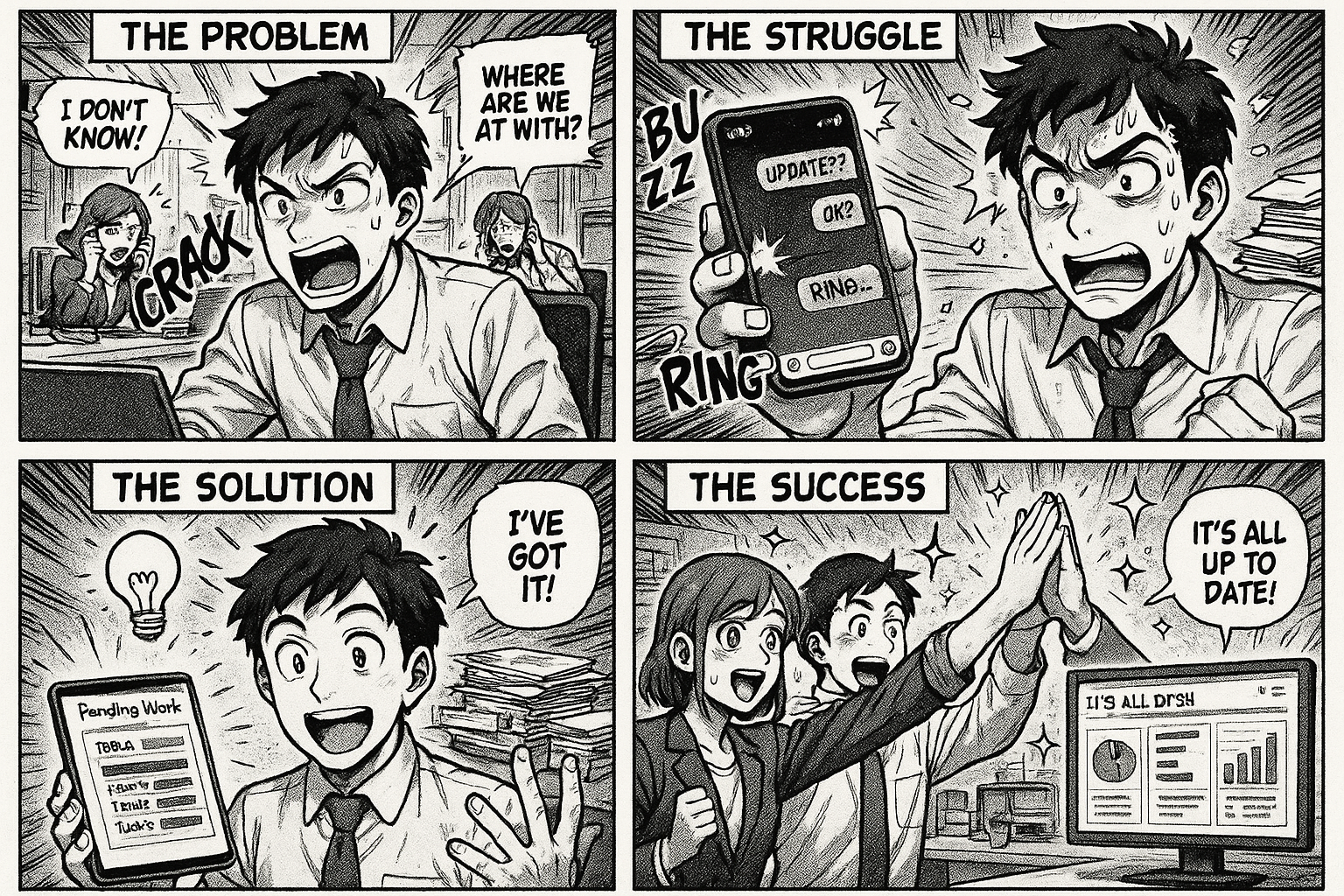
How to Track Pending Work Across Your Team Without Daily Meetings
Every morning, the same ritual: a 30-minute meeting where each person lists what they're working on, what's stuck, and what they need. Everyone nods. Nothing changes. Tomorrow, same meeting.
What if you could see everyone's pending work on a screen — updated in real time — without asking anyone?
Why Daily Status Meetings Fail
They're backward-looking
"Yesterday I worked on X." That's nice, but what does the team need to know about X? Is it done? Is it stuck? Does someone else need to act on it?
They rely on memory
"I think I sent the PO to the vendor... let me check." If the status lives in someone's head, the meeting is just a memory retrieval exercise.
They don't scale
5 people, 10 minutes each = 50 minutes. Every day. That's 4+ hours per week spent talking about work instead of doing work.
Nothing gets captured
After the meeting, what changes? Did anyone write down the action items? Will anyone check if they got done? Usually, no.
What Actually Works: Structured Processes
Instead of asking people what they're doing, make the work itself trackable.
When a purchase order moves from "Pending Approval" to "Approved," the system knows. When a maintenance ticket stays open for 5 days, the system flags it. When a QC sample is tested, the result is recorded.
You don't need a meeting to know the status. You look at the dashboard.
What Your Dashboard Shows
Per process:
- How many items are at each stage
- What's overdue
- Who's assigned to what
Per person:
- How many tasks are pending
- Average response time
- Completion rate
Attention items:
- 3 POs delayed beyond lead time
- 2 maintenance tickets open 10+ days
- 5 leave requests pending approval
Click any number → see the actual items. Click an item → open it.
The Cultural Shift
The first week feels uncomfortable. People aren't used to their work being visible. "Why is the system showing I have 8 pending items?"
By week two, they love it. Because now, when someone asks "did you send the PO?" — the answer is right there. No defensive explanations. No "I was about to do it." The system shows the facts.
Managers stop micromanaging because they can see the status. Employees stop getting interrupted with status-check calls. Everyone wins.
How to Start
Pick one process. The one that generates the most "what's the status?" questions.
Common choices:
- Purchase orders — "did the vendor confirm?"
- Maintenance tickets — "is Machine 3 fixed yet?"
- Leave requests — "did HR approve my leave?"
- Customer complaints — "what happened with that quality issue?"
Set it up as a workflow. Assign people to stages. Let it run for a week. Then cancel your daily status meeting and look at the dashboard instead.
Go to insights.flobri.com/build and describe the process. Deployed in 10 minutes.
Flobri gives teams real-time visibility into pending work — no status meetings, no manual tracking, no "what's the update?" calls.