The Hidden Tax on Every Manufacturing Company That Still Uses Paper
2026-05-22
Every paper form, every manual register, every WhatsApp approval costs your company money you never see on any balance sheet. Here is the math.
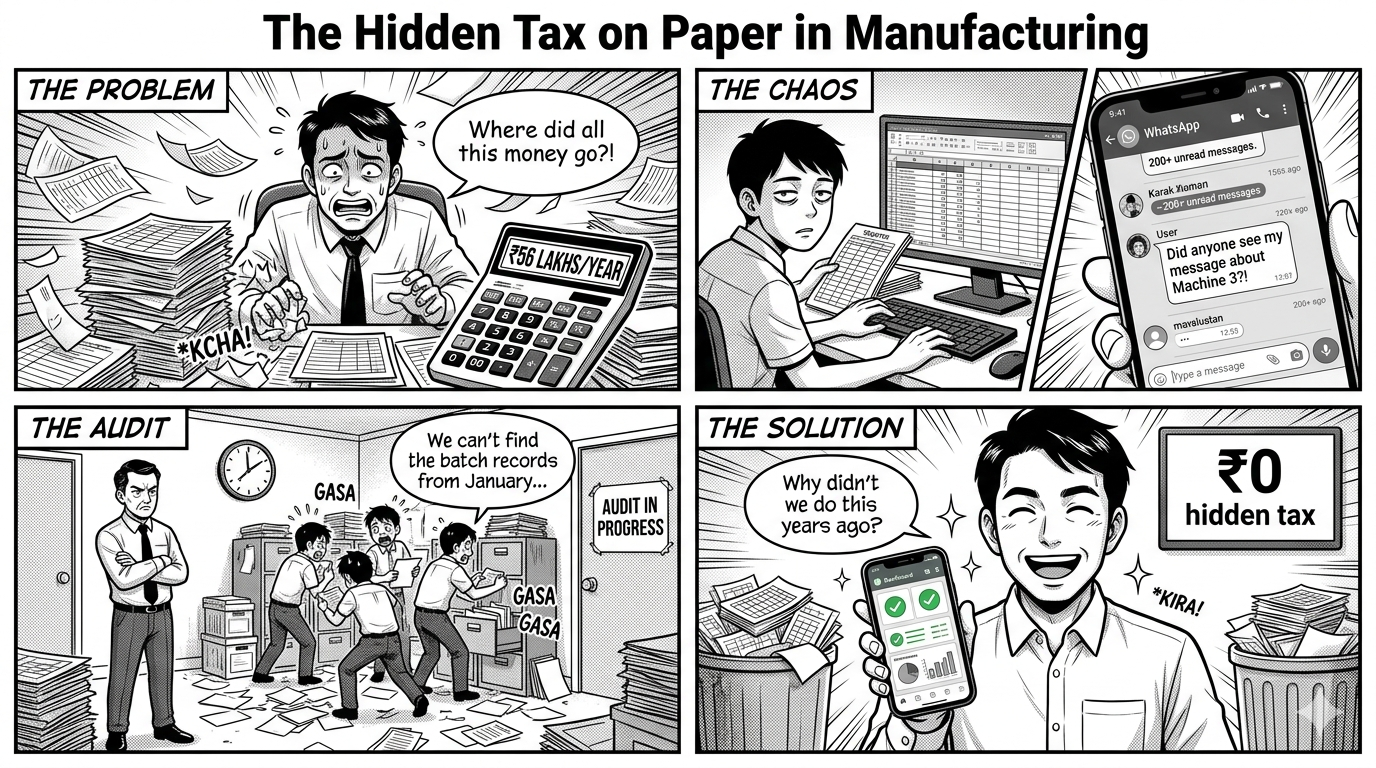
The Hidden Tax on Every Manufacturing Company That Still Uses Paper
Your company doesn't have a line item called "cost of paper-based processes" on its balance sheet. But it's there — hiding inside overtime hours, lost documents, delayed approvals, audit penalties, and the resignations of people who got tired of fighting your broken systems.
This is the hidden tax. Every manufacturing company that still runs on paper registers, WhatsApp approvals, and Excel trackers pays it. Most don't know how much.
Let's do the math.
The 7 Hidden Costs Nobody Tracks
1. The Data Entry Tax — ₹4-8 Lakhs/Year
Every time someone writes a value on a paper form, that value needs to be typed into a computer later. Every. Single. Time.
A typical manufacturing company with 10 SOPs has:
- 5-8 registers filled daily per SOP
- Each register has 10-20 fields
- That's 500-1,600 data points entered on paper daily
- Then re-entered into Excel/ERP by a back-office person
Cost: 1-2 full-time employees doing nothing but data entry. At ₹20,000-35,000/month each, that's ₹4.8-8.4 lakhs/year for work that adds zero value.
2. The Lost Document Tax — ₹2-5 Lakhs/Year
A GRN challan goes missing. A signed batch record can't be found. A vendor invoice was filed in the wrong folder.
Each lost document triggers:
- 2-4 hours of searching
- Phone calls to vendors/departments
- Re-creation of the document from memory
- Sometimes: payment disputes, delayed shipments, audit findings
Most companies lose 5-10 documents per month. Each costs 3-8 hours of someone's time plus the downstream impact.
Cost: ₹2-5 lakhs/year in wasted time and dispute resolution.
3. The Approval Delay Tax — ₹5-15 Lakhs/Year
A purchase order needs approval. The manager is in a meeting. The PO sits on their desk for 2 days. The vendor delivery is delayed by 2 days. Production waits.
In a paper/WhatsApp system:
- Average approval time: 2-5 days
- In a digital workflow: 2-4 hours
- Difference: 1.5-4.5 days per approval
Multiply by 50-100 approvals per month. That's 75-450 days of cumulative delay per month across all processes.
Cost: Delayed production, emergency purchases at premium prices, overtime to catch up — easily ₹5-15 lakhs/year.
4. The WhatsApp Chaos Tax — ₹3-6 Lakhs/Year
Your shift supervisor sends a WhatsApp message at 11 PM: "Machine #3 bearing noise." The maintenance head sees it at 7 AM under 47 other messages. By then, the bearing has failed.
- Critical messages buried in group chats
- No tracking of who read what, who acted, who didn't
- No accountability — "I didn't see the message"
- No history — phone changes, chats lost
Cost: Delayed responses to critical issues, repeat breakdowns, zero traceability — ₹3-6 lakhs/year in preventable failures.
5. The Audit Preparation Tax — ₹2-4 Lakhs/Year
An audit is announced. Your quality team drops everything for 2-3 weeks to:
- Collect batch records from filing cabinets
- Organize deviation reports chronologically
- Find missing signatures
- Prepare binders that should have been ready all along
2-3 people × 2-3 weeks × 2-4 audits per year = 8-24 person-weeks spent on audit preparation.
Cost: ₹2-4 lakhs/year in productive time lost — plus the findings for missing documentation.
6. The Employee Turnover Tax — ₹5-10 Lakhs/Year
Your best quality manager quits. Not for more money — for less frustration. She spent 60% of her day on paperwork that a simple workflow could handle.
Replacement cost:
- 2-3 months to hire
- 3-6 months to train
- Knowledge loss (those Excel sheets nobody else understands)
- Team morale impact
Losing one skilled person costs 50-200% of their annual salary.
Cost: Even one preventable resignation costs ₹5-10 lakhs in replacement, training, and productivity loss.
7. The Invisible Error Tax — ₹3-8 Lakhs/Year
A temperature reading is written as 45°C instead of 54°C. A batch number is transposed. A quantity is entered in grams instead of kilograms.
Paper doesn't validate. Paper doesn't auto-calculate. Paper doesn't flag impossible values.
Each error that reaches a customer costs 10-100x more to fix than catching it at source:
- Customer complaints
- Product returns
- Rework
- Lost trust
Cost: ₹3-8 lakhs/year in quality failures that a dropdown menu or validation rule would have prevented.
The Total Hidden Tax
| Hidden Cost | Annual Range |
|---|---|
| Data Entry | ₹4-8 L |
| Lost Documents | ₹2-5 L |
| Approval Delays | ₹5-15 L |
| WhatsApp Chaos | ₹3-6 L |
| Audit Preparation | ₹2-4 L |
| Employee Turnover | ₹5-10 L |
| Invisible Errors | ₹3-8 L |
| Total | ₹24-56 L/year |
A mid-size manufacturing company pays ₹24-56 lakhs per year in hidden costs — just for the privilege of using paper.
That's not a cost anyone budgets for. It's not a line item anyone reviews. It's a tax that's been there so long, everyone assumes it's normal.
The Math on Going Digital
A workflow platform that replaces paper costs ₹1-3 lakhs/year.
Return on investment: 8-56x in the first year alone.
But the real ROI isn't the money. It's:
- Your quality manager doing quality work instead of paperwork
- Your plant head seeing real-time data instead of yesterday's register
- Your auditor finding everything in 5 minutes instead of 5 days
- Your best employees staying because the system works FOR them, not against them
The One Question
If someone told you there's a ₹24-56 lakh bill sitting on your desk that you've been paying every year without knowing — would you at least look at it?
The paper on your factory floor is that bill.
Flobri replaces paper registers with digital workflows in under a week — no IT team needed, works on any phone. Stop paying the hidden tax →