The Monday Morning Meeting That Runs Itself — What Happens When Your Data Is Already There
2026-05-26
Most factory meetings are 60 minutes of people reading from registers and explaining what happened last week. What if you walked in and the answers were already on the screen?
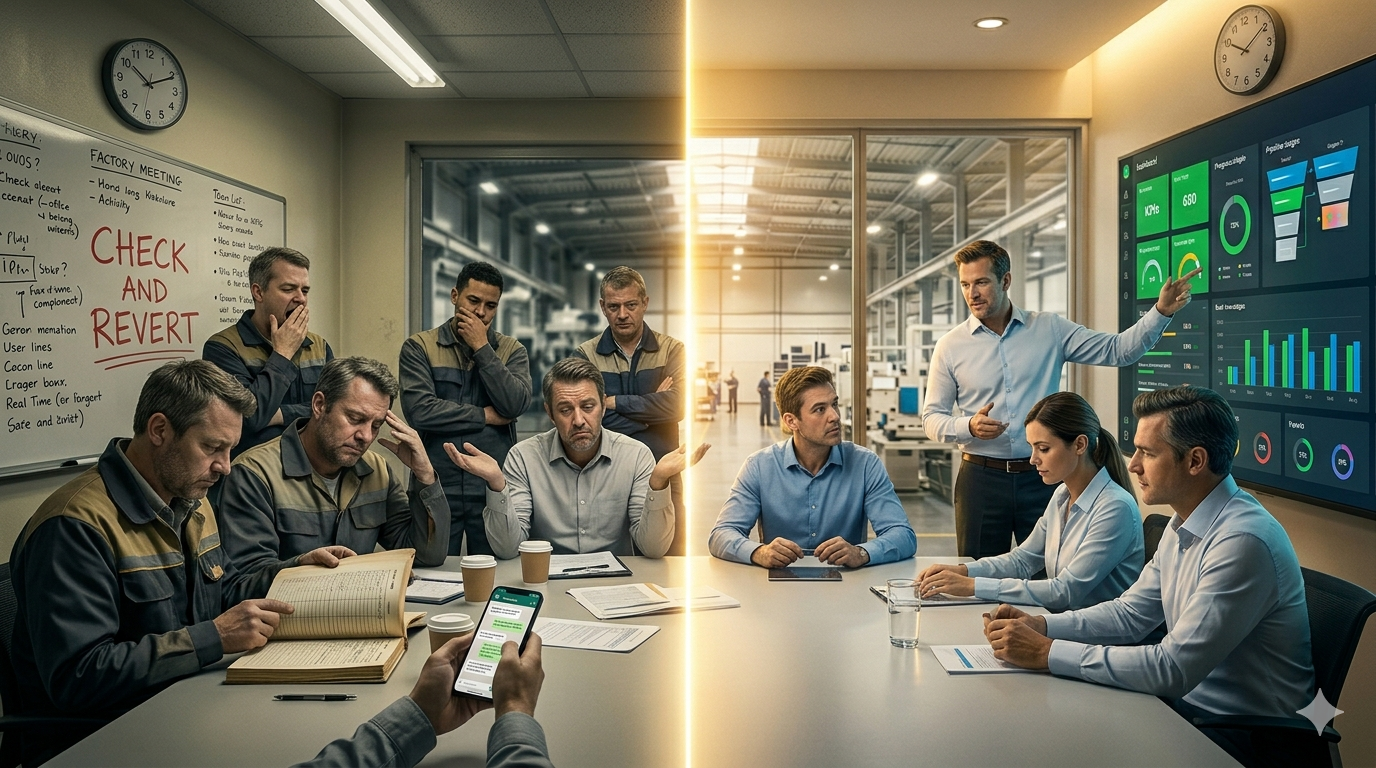
The Monday Morning Meeting That Runs Itself — What Happens When Your Data Is Already There
It's Monday, 9:15 AM. Your weekly operations meeting.
Eight people sit around a table. The plant head asks: "What's the status of last week's production?"
What follows is a ritual every manufacturing company knows:
- The production supervisor opens a register. Flips pages. Reads numbers from Friday. Doesn't have Thursday's numbers because that register is in the other building.
- The QC head says "I'll check and get back to you." (They always say this. They always get back 3 days later.)
- The procurement coordinator starts scrolling through WhatsApp messages to find the PO status.
- The maintenance head says "Machine 3 is fixed" but can't tell you when it broke or how long it was down.
- Someone asks about the GRN from last Tuesday. Nobody knows where the challan is.
Sixty minutes pass. The meeting produced 12 action items, all of which are "check and revert."
Now imagine a different Monday.
The Meeting That Already Has Answers
9:00 AM. Same room. Same people. One difference: there's a screen on the wall.
The plant head walks in, looks at the dashboard, and says:
"I can see 47 items are stuck in QC — 12 of them are overdue. Ravi, what's happening with the 12?"
Ravi doesn't need to check. The dashboard already shows which items, which clients, how many days overdue, and who's assigned.
"Machine 3 went down Thursday at 2:14 PM and came back up at 6:30 PM. 4 hours 16 minutes of downtime. Maintenance team, why did it take that long for a bearing replacement?"
No register flipping. No "I'll check." The data is already there.
"We received 240 GRNs last week. 18 are pending QC. 6 have been pending for more than 5 days. Here they are — vendor name, material, quantity, GRN number. Who's handling these 6?"
Click. Names show up. Assignments are clear.
The same meeting now takes 20 minutes. Every question has an answer. Every action item has a deadline and an owner.
What Changes When Data Arrives Before People Do
1. Meetings Become Decision Meetings, Not Status Meetings
The old meeting: 80% status updates ("here's what happened"), 20% decisions.
The new meeting: 0% status updates (the dashboard already shows everything), 100% decisions ("here's what we're doing about it").
Your 60-minute meeting becomes a 20-minute meeting. Your 8 people get 40 minutes back. That's 5.3 hours of collective productivity recovered every week from one meeting alone.
2. Nobody Can Hide Behind "I'll Check"
When the data is on the screen, there's no buffer. "How many are pending?" isn't a question anymore — it's a number everyone can see.
The person responsible can't deflect. They can't round down. They can't say "approximately." The number is right there: 47. Not "around 40-50." Forty-seven.
This isn't about blame. It's about clarity. When everyone sees the same number, the conversation moves to "why" and "how to fix" instead of "what's the status."
3. Problems Are Caught Monday, Not Thursday
In a paper-based meeting, problems surface when someone remembers to mention them. A deviation from Friday might not come up until someone asks the right question.
With a dashboard, overdue items are flagged automatically. The plant head doesn't need to ask — the red badges on the screen are screaming "pay attention to me."
A problem caught Monday costs 1x to fix. The same problem discovered Thursday costs 5x — because by Thursday, 3 more batches have gone through the same broken process.
4. The CEO Doesn't Need to Attend
Here's the real power: the CEO doesn't even need to be in the meeting.
They can open the same dashboard from their phone at 8:55 AM. They already know what's stuck, what's overdue, what's on track. If something needs their input, they'll see it in the data.
The meeting happens for the operations team to coordinate. The CEO monitors from the dashboard. Two hours per week returned to the CEO — for work that actually requires a CEO.
5. Historical Context Is Automatic
"How does this week compare to last week?"
In a paper meeting, nobody knows. Someone might guess.
With a dashboard: "Last week: 38 items stuck in QC. This week: 47. That's a 24% increase. Something changed — let's figure out what."
Trend visibility turns reactive management into proactive management. You don't wait for the problem to become a crisis. You see it building.
The Five Numbers That Should Be on the Screen
You don't need 50 KPIs. Start with these 5:
| # | Number | Why It Matters |
|---|---|---|
| 1 | Items stuck > X days | Shows bottlenecks before they cause delays |
| 2 | Overdue by stage | Tells you WHERE the problem is |
| 3 | Assigned to whom | Tells you WHO needs to act |
| 4 | Received vs completed (this week) | Shows if you're falling behind |
| 5 | Top 3 overdue items | The specific things that need attention today |
That's it. Five numbers. If your Monday meeting starts with these on the screen, you've already saved 40 minutes.
The Transition Week
You can't go from paper to dashboard overnight. Here's a realistic transition:
Week 1: Pick one process. Digitize it. Run the Monday meeting with both the paper register and the dashboard on screen. Let people see the difference.
Week 2: Stop reading from the register for that process. Use only the dashboard. People will resist. The data might have gaps. That's fine — the gaps show you where the process isn't being followed.
Week 3: Add a second process. The team now expects data on screen. They'll start asking "why isn't this one digital yet?"
Week 4: The meeting runs in 20 minutes. Someone says: "Can we do this for maintenance too?" That's when you know it's working.
The Real Test
Here's how you know your Monday meeting has transformed:
Old meeting: Plant head asks a question. Someone leaves the room to get a register.
New meeting: Plant head asks a question. Someone points at the screen.
When pointing replaces fetching, you've won.
What Happens to the Extra 40 Minutes
The plant head uses it for a floor walk — actually talking to operators instead of sitting in a meeting.
The QC head uses it to investigate the recurring deviation instead of compiling status reports.
The procurement coordinator uses it to negotiate with vendors instead of chasing approvals.
The CEO uses it to think about strategy instead of asking "what's the status."
The meeting didn't just get shorter. It freed everyone to do the work that matters.
One Question for Next Monday
Before your next Monday meeting, ask yourself:
"How many of the questions I'm about to ask could be answered by a screen before anyone opens their mouth?"
If the answer is "most of them" — you don't have a meeting problem. You have a visibility problem. And visibility is one process away from being solved.
Flobri turns your processes into dashboards — every pending item, every overdue task, every bottleneck visible in real-time. Your Monday meeting will never be the same. Make your meetings matter →