What Happens When Your Night Shift Has No Access to SOPs — The 3 AM Problem
2026-05-15
At 3 AM your night shift faces a deviation, but the SOP binder is locked in the quality office and the supervisor isn't answering. This is the 3 AM problem — and it's costing you more than you think.
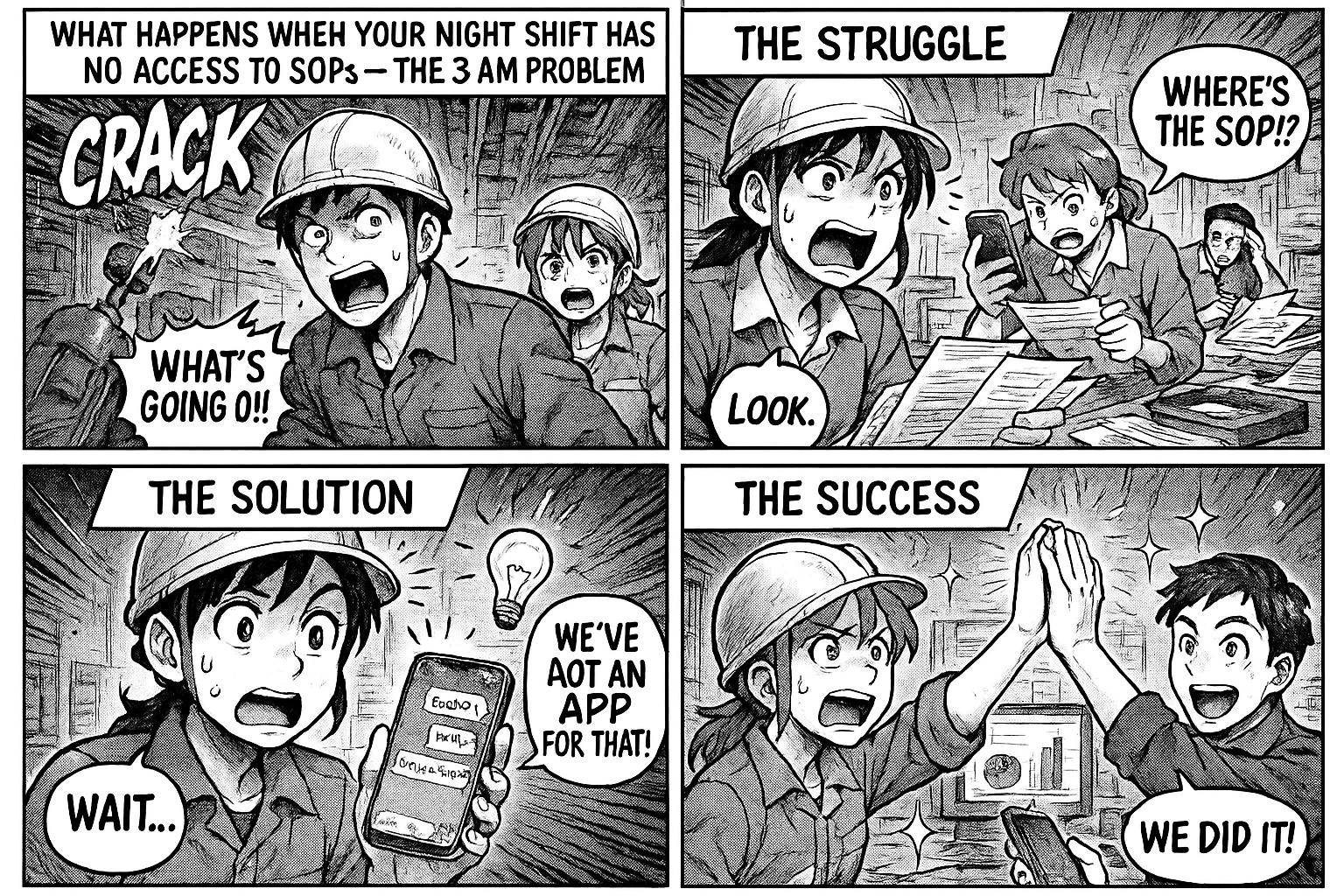
What Happens When Your Night Shift Has No Access to SOPs — The 3 AM Problem
It's 3:07 AM. Your night shift operator notices something wrong with the granulation moisture reading. It's 2.3% above the upper limit.
Here's what should happen:
1. Operator checks the SOP for acceptable range and action protocol
2. Records the deviation with details
3. Follows the defined corrective action
4. Notifies the supervisor
5. Documents everything for the batch record
Here's what actually happens:
1. Operator walks to the quality office. It's locked.
2. Tries to call the shift supervisor. No answer.
3. Calls the QC manager. Phone is on silent — it's 3 AM.
4. Asks a senior operator. "Just dry it for 10 more minutes, it'll be fine."
5. Nothing is documented.
Two weeks later, during an internal audit, someone asks: "Why does this batch show extended drying time with no deviation report?"
Nobody knows. Nobody remembers. The batch record says nothing.
The 3 AM Problem Is Universal
Every manufacturing company that runs multiple shifts has this problem. The details change — it's a different parameter, a different machine, a different missing document — but the pattern is always the same:
Information is available during the day and inaccessible at night.
What's available at 10 AM but not at 3 AM:
- SOP binders (locked in the quality office)
- Master batch records (filed in the document control room)
- Equipment manuals (in the maintenance supervisor's desk)
- Vendor certificates of analysis (in procurement's filing cabinet)
- The quality manager's phone number (in someone's WhatsApp contacts, not in a system)
What's available at 3 AM:
- The operator's experience (which varies wildly)
- Informal knowledge passed down verbally
- A WhatsApp group that may or may not get a response
The Cost Nobody Calculates
1. Undocumented Deviations
The biggest cost isn't the deviation itself — it's the deviation that never gets recorded. When operators can't access the proper procedure, they improvise. When they improvise successfully, it becomes invisible. When it fails, it's a batch loss with no traceable root cause.
2. Inconsistent Decisions
Day shift follows the SOP because the quality manager is watching. Night shift follows tribal knowledge because the SOP is in a locked room. You now have two different processes running under the same SOP number.
3. Delayed Escalation
A deviation at 3 AM gets reported at 8 AM when the day shift arrives. By then, the batch has moved to the next stage. Corrective action that should have taken 30 minutes now requires rework that takes 8 hours.
4. Audit Findings
Auditors love asking about night shift procedures. "Show me a deviation that was raised during the second shift." If your answer is "deviations don't happen at night," the auditor knows exactly what's going on.
5. Safety Incidents
The most dangerous equipment incidents happen during night shifts — not because equipment fails more at night, but because operators have less support, less documentation access, and less confidence to stop the line.
Why This Problem Persists
Companies know about the 3 AM problem. They've tried to solve it:
"We laminated the SOPs and put them on the wall."
Great — until the SOP is revised. Now you have an outdated laminated version next to a current version nobody can find.
"We gave the shift supervisor a laptop."
The laptop stays in the supervisor's office. When the supervisor is doing rounds, it's sitting on a desk being useless.
"We put SOPs on the shared drive."
The factory floor has no PC. Even if it did, finding the right document in a folder structure designed by someone in 2014 takes longer than calling the QC manager.
"We added a night shift quality person."
Expensive. And they can't be everywhere. You've added one person to cover a problem that every operator faces.
The Real Solution: SOPs That Live Where Workers Are
The 3 AM problem isn't a people problem or a training problem. It's an access problem. The information exists. It's just trapped in physical binders, desktop computers, and locked offices.
The fix:
1. Every SOP is a Workflow on Every Phone
The operator doesn't need to "find" the SOP. When they're assigned to a batch, the relevant procedure — with the right fields, the right limits, the right actions — is already on their screen.
2. Deviations Are Part of the Flow
When a parameter is out of spec, the system doesn't require the operator to go find a deviation form. The deviation is a branch in the workflow. Tap "Out of Spec" → deviation form appears with batch details pre-filled → corrective action options listed.
3. Escalation Is Automatic
The system notifies the supervisor and QC manager instantly. Not through WhatsApp, not through a phone call the operator hopes someone answers. A push notification with the batch number, parameter, reading, and deviation details.
4. The Record Creates Itself
Every action taken at 3 AM — the reading, the deviation, the corrective action, the supervisor acknowledgment — is timestamped and attributed. When the auditor asks, the record is already there.
5. It Works Offline
Factory WiFi is unreliable. The workflow app caches the current procedure. The operator can complete their work offline. When connectivity returns, everything syncs.
What Changes After You Solve the 3 AM Problem
- Night shift deviations get documented — because documentation is part of the workflow, not a separate step
- Response time drops from hours to minutes — because escalation is automatic
- Day and night shifts follow the same process — because the process is the app, not a binder
- Audit confidence goes up — because every shift, every batch, every decision is recorded
- Safety improves — because operators have immediate access to procedures and know exactly when to stop
One Question to Ask Tomorrow
Walk into your factory at shift change and ask the outgoing night shift operator:
"If something went wrong tonight, where would you look up the procedure?"
If the answer involves a locked room, a sleeping supervisor, or "I just know from experience" — you have the 3 AM problem.
And now you know how to fix it.
Flobri puts your SOPs on every operator's phone — with the right fields, automatic escalation, and offline support. Night shift or day shift, the process is the same. Try it free →