Why Fashion Brands Ship Late and Lose Retailers — The Production Tracking Problem Nobody Solves
2026-05-16
Fashion brands manage sampling, production, quality checks, and shipments across dozens of vendors — usually through WhatsApp and Excel. Here's why orders ship late and how workflow automation fixes it.
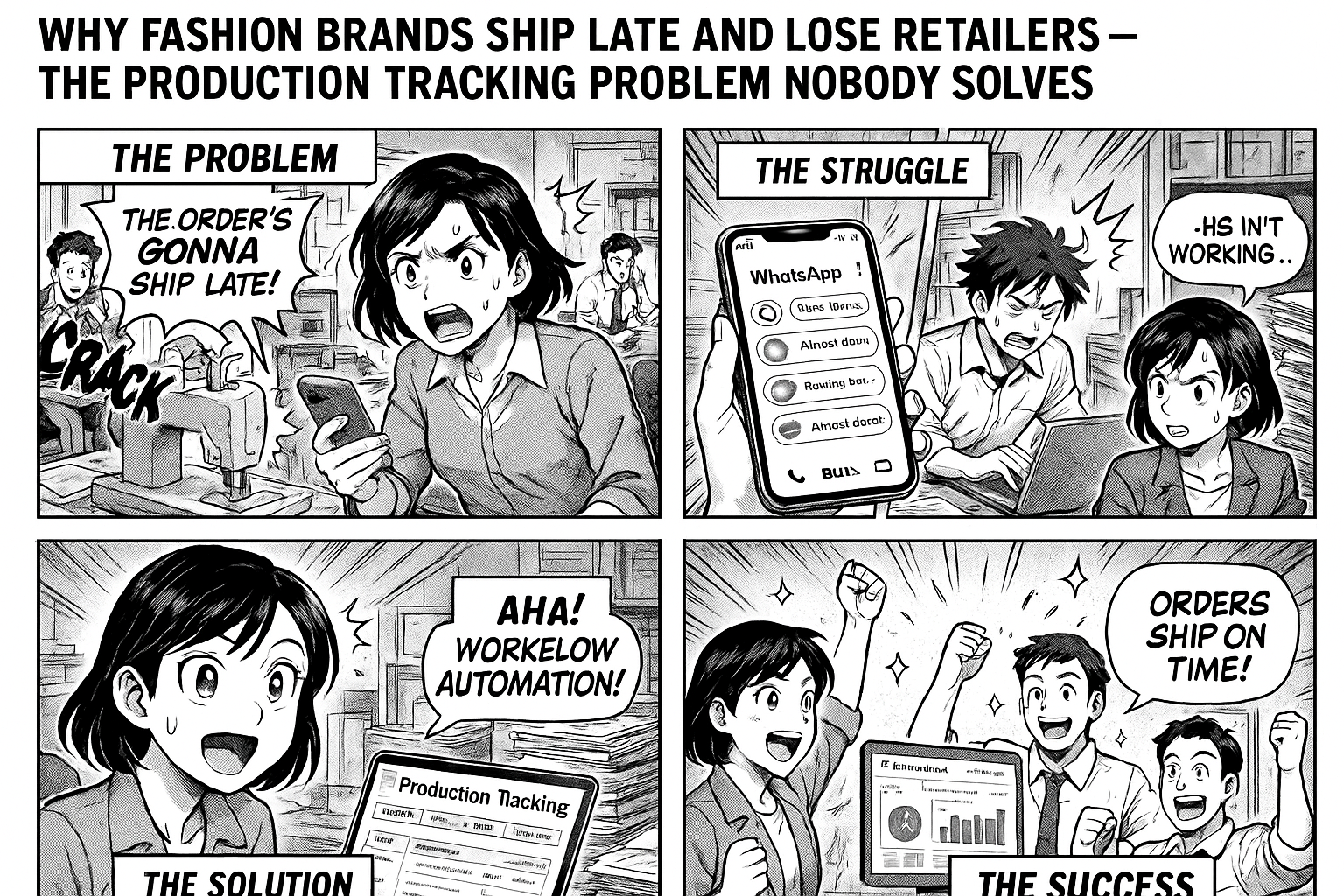
Why Fashion Brands Ship Late and Lose Retailers — The Production Tracking Problem Nobody Solves
You're a fashion brand. You've designed the collection, taken orders from retailers, placed production orders with your manufacturers. Now you need to deliver 15,000 pieces across 8 styles in 45 days.
Here's what actually happens:
- Day 1-5: Fabric sourcing delays (vendor promised delivery in 3 days, took 10)
- Day 12: Sampling approved, but you realize one colorway doesn't match the original
- Day 18: Production starts on 6 of 8 styles. Two are waiting for trims that haven't arrived.
- Day 25: You WhatsApp the factory. "How many pieces done?" Reply: "Going on, sir."
- Day 30: Factory sends photos. Quality issues on 2 styles. Stitching defects, wrong label placement.
- Day 38: Rework delays push everything back a week.
- Day 45: You've shipped 60% of the order. The rest ships 2 weeks late.
- Day 60: Retailer deducts penalties. Cancels the late-arriving styles. Doesn't reorder next season.
You didn't lose the retailer because of design. You lost them because you couldn't track production.
The Fashion Production Visibility Problem
Fashion brands — whether they're D2C labels, private labels, or wholesale brands — share the same operational blind spot: they have no real-time visibility into where their production stands.
The typical production flow for a fashion brand:
1. Design & Sampling (2-4 weeks)
Design finalized → Tech pack created → Sample sent to manufacturer → Sample received → Fitting check → Revisions → Final sample approved
2. Raw Material Sourcing (1-3 weeks)
Fabric order placed → Fabric received & inspected → Trims ordered (buttons, zippers, labels, tags, packaging) → Trims received → All materials sent to factory
3. Production (3-6 weeks)
Cutting → Stitching/Assembly → Washing/finishing → Quality check → Ironing/pressing → Packing
4. Quality Control (overlaps with production)
In-line inspection → Pre-final inspection → Final inspection → AQL check → Defects logged → Rework if needed
5. Shipping & Delivery
Packed cartons counted → Shipping labels created → Logistics booked → Dispatched → Delivery confirmed → Invoice raised → Payment tracked
That's 30-40 steps across 5-10 vendors for a single style. Multiply by 8-15 styles per season. Now try managing all of that through WhatsApp and Excel.
How Fashion Brands Actually Track Production Today
| Method | Reality |
|---|---|
| "Bhai, status kya hai?" "Going on, sir." No dates, no numbers, no accountability. | |
| Excel tracker | Updated once a week (if at all). By the time you see a delay, it's too late. |
| Factory replies in 2 days. By then, 1000 more defective pieces have been cut. | |
| Factory visits | You can't visit 5 factories every week. And they show you the good stuff. |
| Phone calls | "We'll deliver by Friday." Friday comes. "Next Wednesday." |
The result: you find out about problems when they're already too expensive to fix.
What Goes Wrong (and What It Costs)
Sampling Delays
Every day of sampling delay pushes the production start date. A 5-day sample revision delay means your entire delivery timeline shifts by a week. You won't know until it's too late because sampling status lives in someone's WhatsApp chat.
Fabric & Trim Mismatches
Wrong shade of fabric. Missing care labels. Incorrect button color. These should be caught at incoming inspection. But there's no incoming inspection process — the material goes straight to cutting.
Production Bottlenecks
Factory accepted 5 brands' orders simultaneously. Yours is lowest priority. You won't know until you call on day 20 and hear "we haven't started yet." If you had daily production numbers, you'd have caught this on day 3.
Quality Issues Caught Late
Defects found after 5,000 pieces are stitched cost 10x more to fix than defects caught after 50 pieces. Without in-line quality checks at defined intervals, you're always catching problems at the end.
Retailer Penalties
Late delivery = penalty deductions (typically 1-2% per week). Partial delivery = order cancellation for remaining quantity. Two late seasons = retailer drops you.
What Workflow-Driven Fashion Production Looks Like
Style-Level Tracking
Each style is a workflow with stages:
1. Tech Pack Ready → Design team uploads tech pack, BOM (bill of materials)
2. Sample Sent → Factory assigned, sample deadline set, auto-reminder
3. Sample Approved → Photos uploaded, fit comments logged, approval recorded
4. Material Sourced → Fabric PO placed, trim POs placed, delivery dates tracked
5. Material at Factory → Inspection done, quantity confirmed, production can begin
6. Cutting Complete → Pieces cut logged, wastage recorded
7. Production In Progress → Daily output tracked (target vs actual)
8. QC Passed → Inspection report uploaded, defect rate logged
9. Packed & Ready → Carton count, packing list, shipping label
10. Dispatched → Logistics details, tracking number, delivery confirmation
11. Invoiced → Invoice raised, payment due date set, payment tracked
What Changes
For the brand owner:
- One dashboard showing all styles, all factories, all stages
- Red flags on delays BEFORE they become crises
- Quality data by factory, by style, by defect type
For the merchandiser:
- No more "WhatsApp checking" as a job description
- Auto-reminders to factories at each milestone
- Photo evidence at each stage (cutting, stitching, packing)
For the factory:
- Clear deliverables and deadlines
- One form to fill per stage instead of answering 20 WhatsApp messages
- Documented quality expectations (not verbal)
For the retailer:
- On-time delivery (because the brand catches delays early)
- Consistent quality (because QC is built into the flow)
- Confidence to reorder next season
The Numbers
| Metric | WhatsApp + Excel | Workflow-Driven |
|---|---|---|
| On-time delivery rate | 55-65% | 85-90% |
| Defect rate at final QC | 8-12% | 2-4% |
| Sampling cycle time | 3-4 weeks | 1.5-2 weeks |
| Production visibility | Weekly (if lucky) | Real-time |
| Retailer retention | Season-to-season uncertainty | Multi-season partnerships |
Start With One Season
You don't need to overhaul everything. For your next production cycle:
1. Create one workflow per style with the 11 stages above
2. Assign your merchandiser as the process owner
3. Share the factory stages with your vendor (they fill updates on their phone)
4. Watch the dashboard — you'll see delays in real-time for the first time
5. Ship on time — and watch the retailer's face when you deliver everything as promised
The brands that win in fashion aren't always the ones with the best designs. They're the ones that deliver on time, every time.
Flobri helps fashion brands track every style from sampling to shipment — across all vendors, all stages, all in one dashboard. Try it free →