Why Your Best Employees Quit Over Broken Processes — Not Low Salaries
2026-05-19
The real reason your best people leave isn't money — it's the daily frustration of fighting broken systems, chasing approvals on WhatsApp, and doing work that a simple workflow could handle.
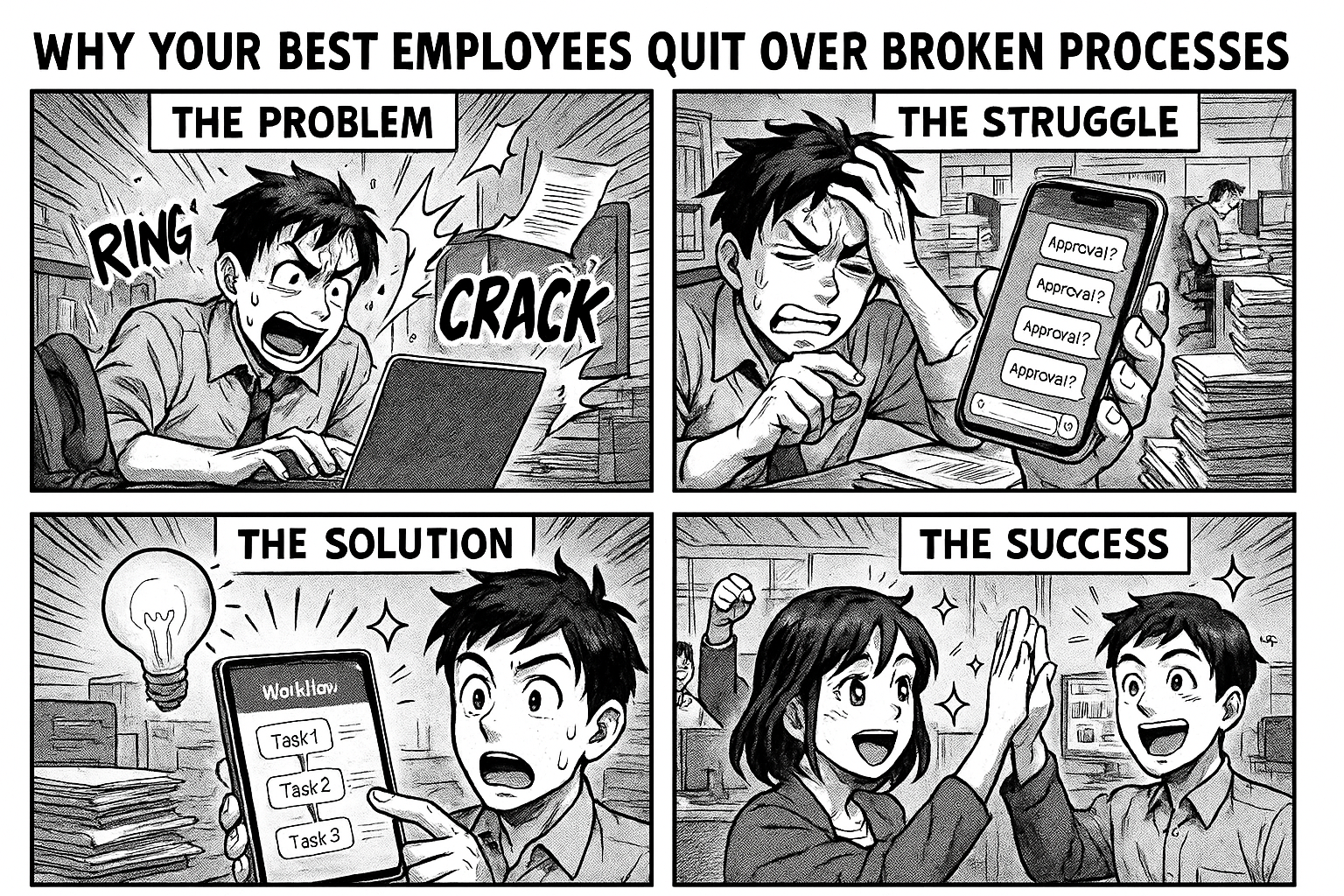
Why Your Best Employees Quit Over Broken Processes — Not Low Salaries
You just lost your best QC manager. She gave two weeks notice, was professional about it, said all the right things in the exit interview. "Looking for new challenges." "Great experience here." "Nothing personal."
But you know the real reason. Everyone knows.
She spent 3 hours every day chasing signatures on paper forms. She sent the same WhatsApp reminder to the same 4 people every morning. She maintained 6 Excel sheets that nobody else understood. She escalated the same recurring problem every month because nobody fixed the root cause.
She didn't leave for more money. She left because she was tired of fighting your broken processes every single day.
The Silent Cost of Broken Processes
When we talk about operational inefficiency, we talk about cost, time, and quality. We rarely talk about the most expensive consequence: losing the people who care the most.
Here's the irony: your worst employees thrive in broken systems. They hide behind confusion, avoid accountability, and blame "the process" for every failure. They'll never leave.
Your best employees — the ones who actually try to make things work — burn out. They're the ones staying late to reconcile data that should auto-sync. They're the ones calling vendors because the PO approval took 5 days. They're the ones who know the process is broken and can't fix it.
Broken processes don't just cost money. They selectively remove your best people.
The 5 Process Failures That Drive Good People Away
1. "I Spend More Time Reporting Work Than Doing Work"
Your quality manager fills out the batch record after completing the inspection. Then fills out the QC log. Then updates the Excel tracker. Then sends a WhatsApp update to the plant head. Then emails the summary to the VP.
Five separate documentation steps for one inspection.
The person who cares about quality is now a full-time data entry clerk. The person you hired for their analytical skills spends 60% of their time on clerical work.
They don't tell you this is why they're frustrated. They just quietly start looking.
2. "I'm Always Chasing Other People"
The procurement coordinator raises a purchase order. Then chases the manager for approval (WhatsApp, email, walk to their desk). Then chases finance for budget confirmation. Then chases the vendor for acknowledgment. Then chases the store for GRN confirmation.
The actual work takes 10 minutes. The chasing takes 3 days.
Your best people become professional naggers. That's not what they signed up for. That's not what keeps them motivated. Every unanswered WhatsApp message chips away at their engagement.
3. "The Same Problem Keeps Happening and Nobody Fixes It"
The same deviation occurs every month. It gets documented (on paper), investigated (superficially — no time for root cause analysis), and closed with "operator will be retrained."
Next month: same deviation, same investigation, same conclusion.
Your best quality person KNOWS the root cause is a process design problem, not operator error. But fixing the process requires changing 3 forms, updating 2 SOPs, getting 4 signatures, and waiting 6 weeks for approval. So they document "operator retrained" for the 12th time and die a little inside.
4. "I Have No Visibility Into What's Happening"
The plant head arrives at 8 AM and asks: "What's the status of yesterday's production?"
Nobody knows. The production log is with the shift supervisor who left at 6 AM. The quality results are in a register in the QC lab. The maintenance tickets are in someone's WhatsApp. The store receipts are in a physical challan file.
Getting yesterday's status requires 5 phone calls, 3 WhatsApp groups, and 2 physical registers.
Good managers want to make data-driven decisions. When there's no data (or getting data takes 2 hours), they make gut decisions — which is exactly what they were trying to avoid when they took the job.
5. "My Ideas Get Buried in Bureaucracy"
A sharp production supervisor suggests: "If we add a checkpoint between mixing and granulation, we'll catch the pH issue before it ruins the batch."
Great idea. To implement it:
- Write a change control request
- Get it approved by QA, production head, and plant head
- Revise the SOP document
- Print new batch record templates
- Train all operators on the change
- Wait for the next internal audit to verify
Timeline: 3-6 months. By then, the supervisor has lost interest, the idea is forgotten, and 15 more batches have been wasted.
When good ideas take 6 months to implement, people stop having ideas.
What Changes When Processes Work
Imagine your QC manager's day if the process wasn't broken:
| Broken Process | Fixed Process |
|---|---|
| Fill batch record on paper, then enter in Excel, then WhatsApp update | Inspection form on phone → batch record auto-generated → plant head sees it on dashboard |
| Chase 4 people for signatures via WhatsApp | Submit → auto-routes to next approver → they get a notification |
| Maintain 6 Excel trackers | Dashboard shows real-time status — nothing to maintain |
| Document same deviation monthly | System flags recurring deviations automatically → root cause investigation triggered |
| Spend 60% of day on documentation | Spend 60% of day on actual quality improvement |
The same person. The same salary. Completely different job satisfaction.
The Retention ROI Nobody Calculates
Replacing a skilled manufacturing employee costs 50-200% of their annual salary:
- Recruitment: 2-3 months to find the right person
- Training: 3-6 months to reach full productivity
- Knowledge loss: The Excel sheets, the tribal knowledge, the vendor relationships — all gone
- Team impact: Remaining team members pick up extra work, increasing their burnout risk
Fixing one broken process costs a fraction of replacing one good employee.
But nobody connects the two. The HR team tracks attrition rates. The operations team tracks process KPIs. Nobody asks: "Did this person leave because our process made their job miserable?"
How to Keep Your Best People
Step 1: Ask Them
Before the exit interview (which is too late), ask your best performers: "What's the most frustrating part of your day?"
You'll hear the same themes:
- Too much paperwork
- Too much chasing
- No visibility
- Same problems recurring
- Ideas take too long to implement
Step 2: Fix One Process
Don't try to fix everything. Pick the process that your best person complains about the most. Turn it into a digital workflow:
- Each step has a clear owner
- Transitions are automatic — no chasing
- Documentation is built into the flow — no separate forms
- Dashboards show real-time status — no Excel trackers
- Changes can be made in minutes — no 6-month change control
Step 3: Show Them You Listened
The biggest retention driver isn't salary, benefits, or title. It's the feeling that management cares about making their work better.
When you fix a broken process that frustrated someone for years, you're telling them: "We heard you. We value your time. We want you to do meaningful work, not clerical work."
That message retains people better than any raise.
The Question Every CEO Should Ask
Next Monday morning, walk up to your best performer — the person you'd be devastated to lose — and ask:
"If you could eliminate one frustrating part of your daily work, what would it be?"
Listen to the answer. Then fix it. Before they fix it by leaving.
Flobri eliminates the process friction that drives good employees away — automated routing, built-in documentation, real-time dashboards, and workflows that change in minutes, not months. Keep your best people →