Why Your Factory Still Runs on WhatsApp Groups — And How to Fix It
2026-05-03
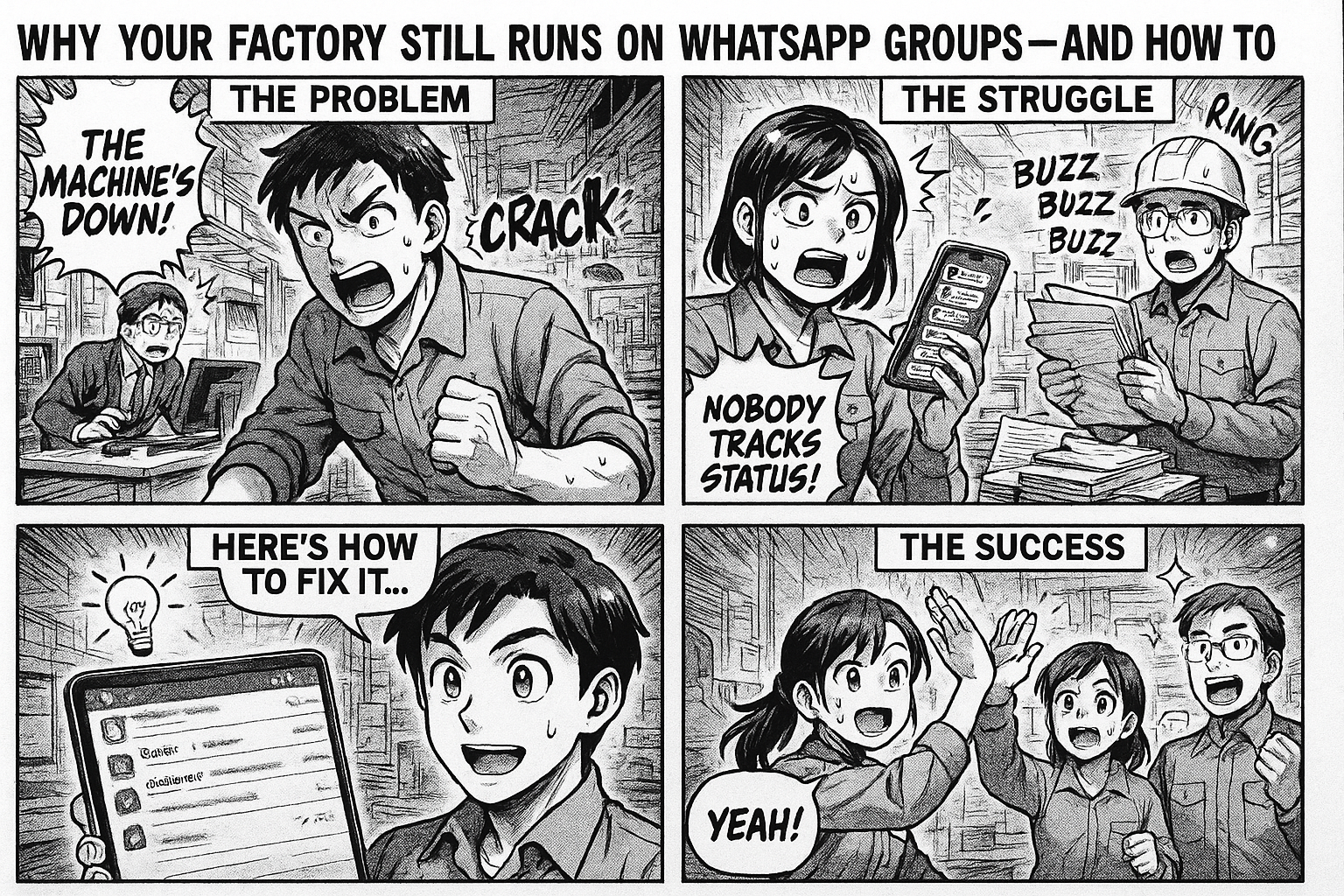
Your factory runs on WhatsApp groups. Nobody tracks status, nothing has accountability, and requests get buried. Here is how to fix it.
Why Your Factory Still Runs on WhatsApp Groups — And How to Fix It
You have a WhatsApp group called "Production Updates." Another one called "Maintenance Issues." One for "Purchase Requests." Maybe one called "Urgent — Plant 2."
Everyone sends messages. Nobody tracks status. Things get done — eventually — but nobody knows what's pending, what's delayed, or who dropped the ball.
Sound familiar?
The WhatsApp Trap
WhatsApp works for conversations. It doesn't work for processes. Here's why:
No Status Tracking
Someone sends "Need 50 kg sodium hydroxide urgently." Three people reply "ok." Did anyone actually create the PO? Did the vendor confirm? When is it arriving? Nobody knows without scrolling through 200 messages.
No Accountability
"I told them in the group" is the most common excuse. But telling someone and assigning someone are different things. In a chat group, everything is everyone's responsibility — which means it's nobody's responsibility.
No History
Try finding that purchase request from 3 weeks ago. Was it in the Production group or the Purchase group? Did Sharma sir approve it or reject it? Good luck scrolling.
No Metrics
How many maintenance tickets did you resolve this month? What's your average PO cycle time? Which vendor delivers the fastest? WhatsApp can't tell you. You'd need to manually count messages.
No Escalation
A request sits unseen for 3 days. Nobody knows. There's no automatic reminder, no escalation, no deadline. Just a message buried under 50 newer messages about other things.
What Companies Actually Need
You don't need a complex ERP system. You need structured processes with three things:
1. Clear ownership — every task is assigned to one person
2. Visible status — everyone can see what's pending, what's done, what's stuck
3. Automatic alerts — overdue items get flagged, not forgotten
That's it. Not a 500-page requirements document. Not a year-long implementation. Just: who needs to do what, and is it done yet?
The Fix: Turn Messages Into Workflows
Take your most common WhatsApp request — say, a purchase request. In WhatsApp, it looks like this:
"Sir, need bearing SKF 6205 for Machine 3. Urgent."
"How many?"
"10 pcs"
"Ok I'll check with vendor"
(3 days later)
"Did we order the bearings?"
"Which bearings?"
In a workflow, the same request looks like this:
1. Maintenance head fills a form: Material = Bearing SKF 6205, Qty = 10, Machine = #3, Priority = Urgent
2. Purchase manager gets notified → approves → PO goes to vendor
3. Everyone can see: PO #4521 → Bearing SKF 6205 → Sent to Vendor → Expected: March 15
4. If delayed: Dashboard shows "1 material delayed beyond lead time" in red
5. History: Click PO #4521 → see who requested, who approved, when ordered, when received
Same information. Structured instead of scattered.
"But Our Team Won't Use Software"
This is the most common objection. And it's valid — if the software is complicated.
That's why the form should be as simple as a WhatsApp message. Three fields: what do you need, how many, when do you need it. The system handles the routing, tracking, and follow-up.
The real question isn't whether your team can use software. It's whether they can afford to keep losing requests in chat groups.
Start With One Process
Don't try to digitize everything at once. Pick your most painful WhatsApp group — the one with the most "did this get done?" messages — and turn that into a workflow.
Common starting points:
- Purchase requests — because delayed materials stop production
- Maintenance tickets — because breakdown follow-up is the worst
- Leave requests — because everyone asks "did my leave get approved?"
- Quality deviations — because compliance needs audit trails
One process. One workflow. One week of data. Then look at the dashboard and see what your WhatsApp group never showed you.
How to Set It Up
Go to insights.flobri.com/build. Describe the process in one line:
"Maintenance team raises a purchase request. Manager approves. Purchase sends to vendor. Store keeper logs receipt."
Click generate. Review the workflow. Deploy. Share the link with your team.
Total time: 10 minutes. Cost: zero to start.
Your WhatsApp groups won't disappear overnight. But the "did this get done?" messages will.
Flobri replaces WhatsApp-based process management with structured, trackable workflows. Built for manufacturing teams who need accountability without complexity.