Workflow Automation for Pharma Manufacturing Companies
2026-05-14
How pharma manufacturing companies digitize their core processes — from batch records to deviation management — with workflow automation that meets GMP requirements.
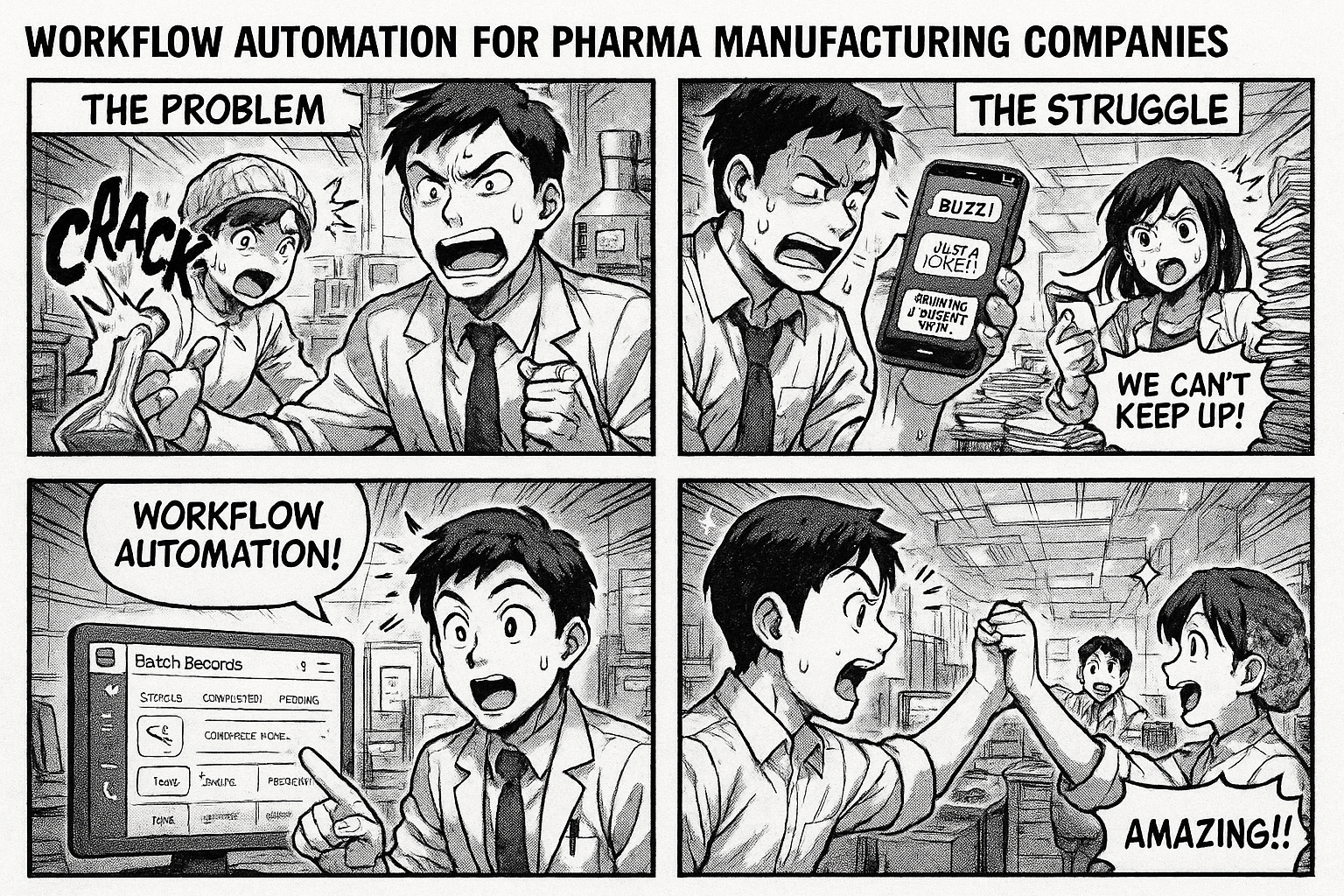
Pharma manufacturing runs on documentation. Every batch, every test, every deviation, every change — documented, signed, reviewed, archived. The irony: most of this documentation still happens on paper.
The Pharma Documentation Burden
A typical pharma factory manages:
- 50-100 active SOPs
- 200+ batch records per month
- 30-50 deviations per quarter
- 20-30 change controls per year
- 500+ calibration events per year
- Continuous training records for 100+ employees
Each document needs signatures, reviews, approvals, and archival. On paper, this requires an army of people just to manage documents — not to make drugs.
What to Automate First
Not everything needs to go digital on day one. Start with the processes that cause the most pain:
1. Deviation Management (Week 1)
Every pharma factory struggles with deviation tracking. Paper deviations get lost, investigations are late, trends go unnoticed. Digitize this first — the ROI is immediate.
What you get: Instant deviation reporting from the floor, automatic escalation for overdue investigations, trend analysis by department/category, CAPA linkage.
2. CAPA Tracking (Week 2)
Once deviations are digital, CAPA tracking follows naturally. Link every CAPA to its source deviation. Track implementation. Verify effectiveness.
What you get: No orphaned CAPAs, deadline tracking with alerts, effectiveness verification reminders.
3. Change Control (Week 3)
Change control is where auditors spend the most time. A digital change control process with impact assessment routing and implementation tracking impresses every auditor.
What you get: Multi-level approval routing based on impact, implementation task tracking, complete audit trail.
4. Calibration Management (Week 4)
Calibration deadlines are non-negotiable. Miss one, and every test result from that instrument is questionable. Auto-scheduling with reminders eliminates missed calibrations.
What you get: Auto-generated calibration tasks, overdue alerts, certificate storage, complete history per instrument.
5. Training Records (Week 5)
Who was trained on what? When? By whom? Was there an assessment? Training records are the #1 most-requested document during audits.
What you get: Training schedule with auto-assignment, attendance tracking, assessment recording, gap analysis.
The GMP Compliance Advantage
Digital workflows inherently satisfy GMP requirements:
| GMP Requirement | How Digital Workflows Meet It |
|---|---|
| Documented procedures | SOPs are version-controlled, always current |
| Trained personnel | Training records linked to SOPs, gaps visible |
| Proper records | Every entry is timestamped and attributed |
| Audit trail | Complete history of who did what, when |
| Deviation handling | Structured workflow with investigation and CAPA |
| Change control | Impact assessment, approval routing, implementation tracking |
| Equipment qualification | Calibration schedules with certificates and history |
What Pharma Companies Typically Build
Based on real implementations:
Quality Systems (QA/QC)
- Deviation management
- CAPA tracking
- Change control
- Out-of-specification (OOS) investigations
- Stability study tracking
- Annual product quality review (APQR)
Production
- Batch manufacturing records
- Equipment logbooks
- Cleaning records
- Environmental monitoring
- Shift handover
Supply Chain
- Purchase orders with approval
- Goods receipt notes (GRN)
- Vendor qualification
- Material dispensing
HR & Admin
- Training management
- Employee onboarding
- Leave management
- KPI reviews
Getting Started
You don't need a 6-month implementation project. Pick one process — the one causing the most audit observations or the most daily frustration — and digitize it.
Go to insights.flobri.com/build, describe the process in plain English, and deploy it in under 10 minutes. Add more processes as your team gets comfortable.
Most pharma companies start with deviation management and expand to cover all quality systems within 2-3 months.
Flobri helps pharma manufacturers digitize quality systems, production records, and compliance processes — with GMP-compliant workflows, audit trails, and instant document retrieval.