Cut Pharma QA Documentation Time by 60%
2026-05-15
QA managers lose most of their day to batch records, deviations, CAPA and change control. How to automate the paperwork and free them for real quality work.
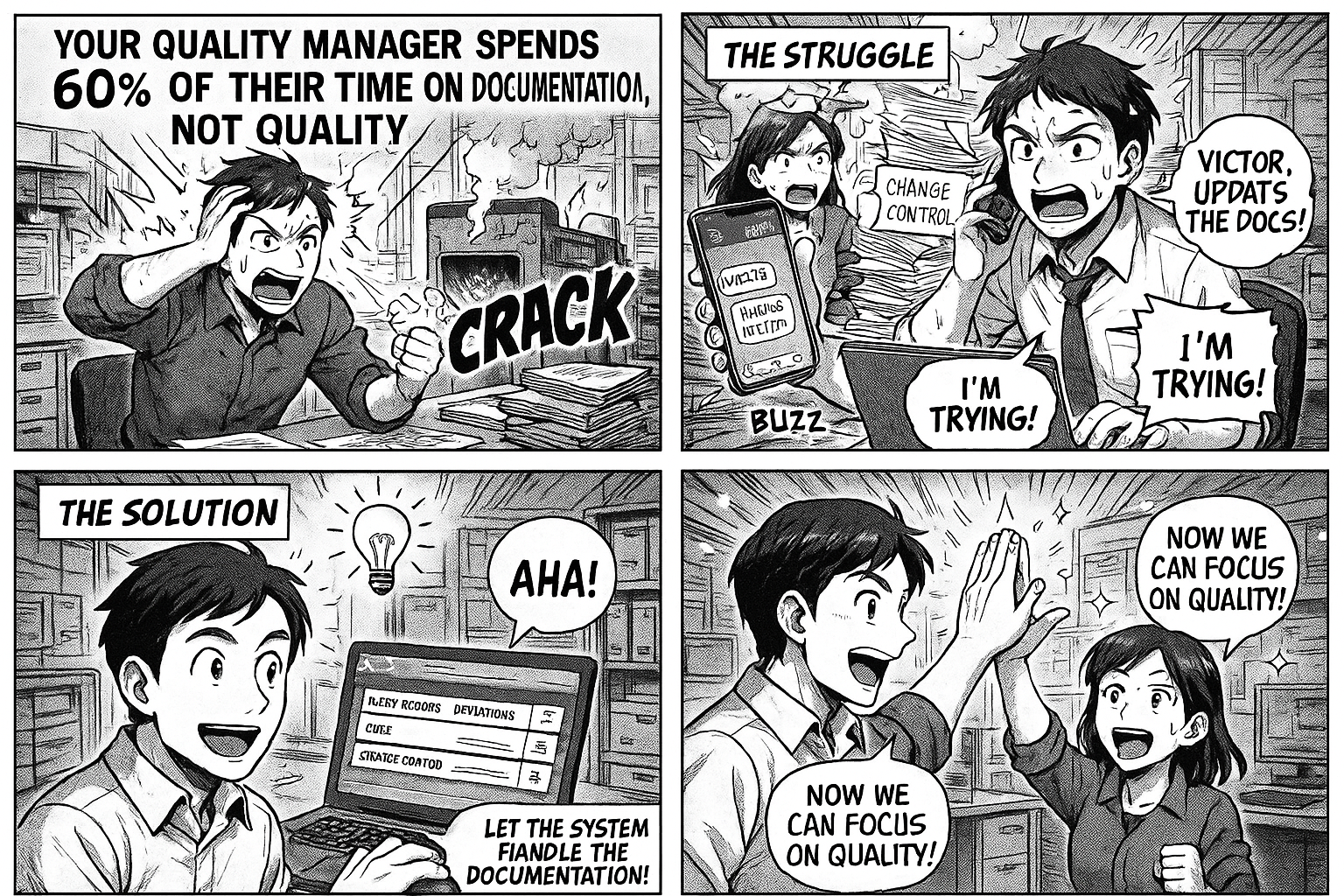
Ask your quality manager what they did today. The answer will probably include:
- Reviewed 12 batch manufacturing records
- Filled out 3 deviation reports
- Updated 2 CAPA logs
- Prepared documents for next week's internal audit
- Chased 4 people for missing signatures
- Filed yesterday's QC test reports
Now ask them: how much time did you spend actually improving quality?
The honest answer, in most manufacturing companies, is close to zero.
The Documentation Trap
Quality management systems are built on a noble principle: document everything so you can trace everything. GMP requires it. ISO demands it. FDA inspects it.
But somewhere along the way, the documentation became the job. Quality managers became professional paperwork handlers. The person you hired to catch problems before they reach the customer is instead:
- Formatting Word documents
- Chasing signatures on paper forms
- Cross-referencing batch numbers across three different registers
- Preparing "audit-ready" binders that nobody reads until the auditor arrives
- Manually numbering deviation reports in sequential order
The Numbers
We analyzed how quality managers in mid-size pharma and manufacturing companies spend their week:
| Activity | Hours/Week | % of Time |
|---|---|---|
| Document review & formatting | 12 | 30% |
| Chasing signatures & approvals | 6 | 15% |
| Filing & organizing records | 4 | 10% |
| Data compilation for reports | 3 | 7.5% |
| Total documentation work | 25 | 62.5% |
| Actual quality investigations | 6 | 15% |
| Process improvement | 3 | 7.5% |
| Training & team development | 2 | 5% |
| Supplier quality management | 2 | 5% |
| Strategic planning | 2 | 5% |
62.5% of a quality manager's time goes to documentation. That's not quality management — that's clerical work with a quality title.
What Gets Sacrificed
When documentation eats the day, the high-value work gets squeezed:
Root Cause Analysis Gets Superficial
Deviations get documented, but the investigation is shallow. "Operator error" becomes the default root cause because nobody has time to dig deeper. The same deviation recurs next month.
Preventive Actions Never Happen
The "P" in CAPA is supposed to be proactive. But when you're drowning in corrective actions and paperwork, prevention is a luxury. You're always reacting, never anticipating.
Supplier Quality Is Reactive
You only look at supplier quality when something goes wrong. There's no time for trend analysis, no capacity for supplier development, no bandwidth for incoming inspection data review.
Training Becomes a Checkbox
Training records exist (they have to), but training effectiveness? Nobody has time to evaluate whether the training actually changed behavior on the floor.
The Irony
The documentation that's supposed to ensure quality is actively preventing quality improvement. Your most qualified person — the one who understands process capability, statistical analysis, and risk management — is reduced to a document controller.
What If the System Handled the Documentation?
Imagine a world where:
- Batch records generate themselves from the workflow. Every parameter entered by an operator is automatically part of the batch record. No separate document to fill.
- Deviation reports auto-populate with batch details, product info, stage, and operator. The quality manager just writes the investigation and corrective action.
- CAPA tracking is the workflow itself. Open a CAPA → assign investigation → review root cause → implement corrective action → verify effectiveness. Each step is a stage with its own form. No Word template, no manual tracking.
- Signatures are digital transitions. When a supervisor moves a batch from "QC Review" to "Approved," that IS the signature. Timestamped, attributed, tamper-proof.
- Audit preparation takes 5 minutes. Filter by date range, product, or batch number. Every record, every transition, every signature — already organized chronologically.
The Quality Manager's New Day
With documentation automated, your quality manager's week looks different:
| Activity | Hours/Week | Change |
|---|---|---|
| Document review (auto-generated) | 3 | -75% |
| Approvals (digital transitions) | 1 | -83% |
| Filing (automatic) | 0 | -100% |
| Data compilation (dashboards) | 0.5 | -83% |
| Quality investigations | 12 | +100% |
| Process improvement | 10 | +233% |
| Training & development | 6 | +200% |
| Supplier quality | 5 | +150% |
| Strategic planning | 2.5 | +25% |
Same 40-hour week. Completely different impact.
How to Start the Shift
You can't change everything overnight, but you can start with the highest-burden process:
1. Identify your #1 documentation time sink. For most companies, it's batch manufacturing records or deviation management.
2. Map it as a workflow. Who does what, in what order, with what data? This becomes your digital process.
3. Make the workflow the record. Every field filled, every transition made, every approval given — that's your documentation. No separate document needed.
4. Free up quality time for quality work. Start with the 10 hours/week you recover from eliminated paperwork.
The Bottom Line
You didn't hire your quality manager to format Word documents. You hired them to ensure your products are safe, consistent, and compliant.
Give them the tools to do that job. Let the system handle the paperwork.
Flobri turns your quality processes into stage-based workflows where the documentation generates itself. Your quality manager can finally focus on quality. Start free →