LIMS for Pharma QC: From Sample Registration to COA Release
2026-06-04
What a pharma QC LIMS does — sample registration, sampling, analysis, two-level review, COA release, stability, OOS, and 21 CFR Part 11 audit trail.
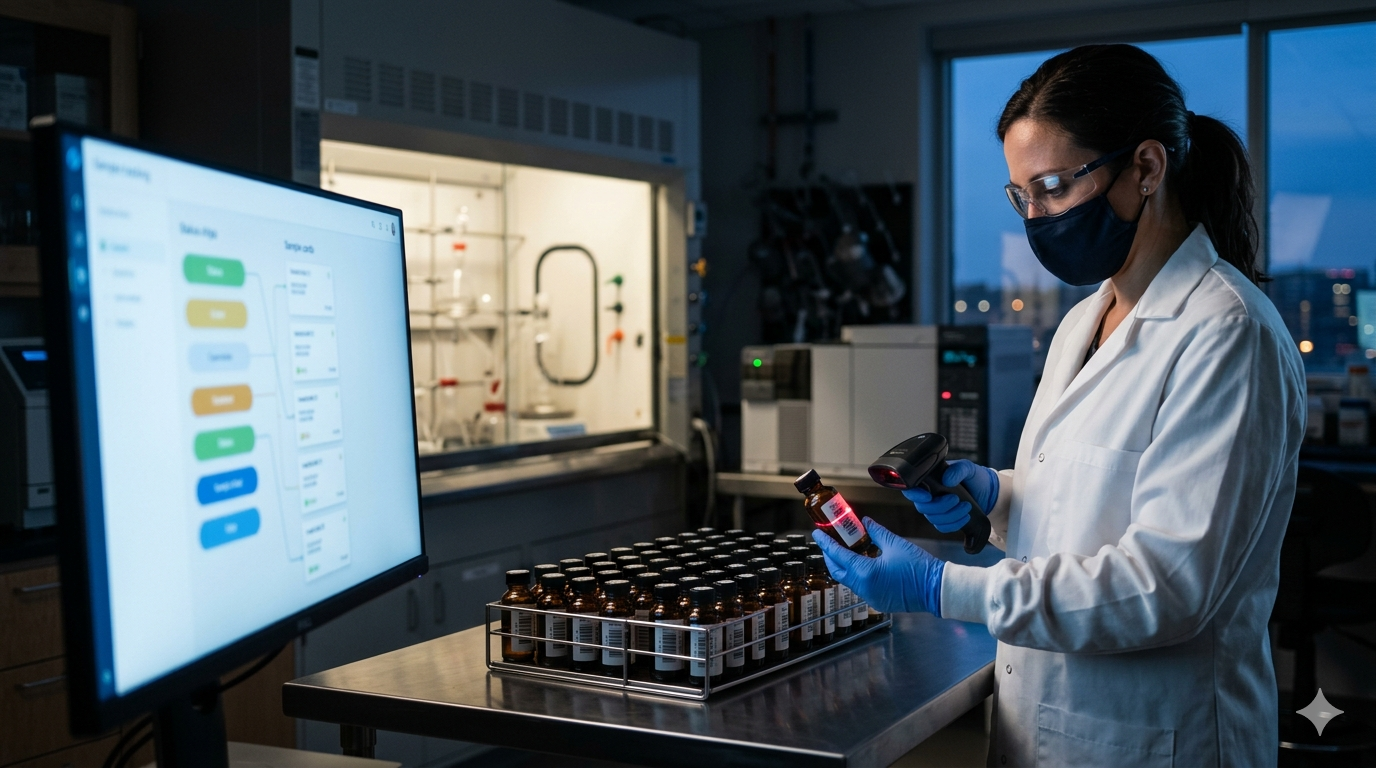
A pharma QC LIMS (Laboratory Information Management System) carries a sample from registration to a released Certificate of Analysis: it logs the sample, assigns tests and specifications, records analyst results, enforces a two-level review, and generates the COA — with a complete audit trail at every step.
A pharmaceutical QC lab can receive hundreds of samples a week — raw materials, packaging, in-process, finished goods, stability pulls, water, micro. Each one has to be registered, sampled, tested against the right specification, reviewed, approved, and released or rejected, with a complete, defensible record at every step. Do that on registers, spreadsheets, and Word reports and you get exactly what regulators flag: transcription errors, missing data, documents that can't be reconciled, and ALCOA+ gaps.
A LIMS (Laboratory Information Management System) exists to replace that with one controlled, auditable flow. This is a practical guide to what a pharma-QC LIMS actually manages — from sample registration to COA release.
What a LIMS is
A LIMS is software that manages samples and their associated quality data through a defined, role-based workflow — built for regulated environments. It isn't a spreadsheet with extra columns; it's a system that enforces who does what, in what order, captures every entry with an audit trail, and produces controlled records (specifications, worksheets, certificates) that hold up under inspection.
The sample lifecycle a LIMS manages
The heart of any QC LIMS is the journey of a single sample. A good system moves it through these stages without a gap:
1. Masters & inspection plans. Before any sample is tested, the lab defines its references: material codes and specifications, test plans, sampling schemes (fixed, percentage, √n+1, AQL), methods, and retest/expiry windows — created, reviewed, and approved once, then reused. Version control matters: changing a spec creates a new version with an effective date, never an overwrite.
2. Sample registration. A sample enters — manually, or automatically when a goods-receipt note is posted in the ERP, or on a stability schedule. The system assigns a unique identification number and captures the essentials: material, batch, quantity, stage, retest/expiry date, category (RM/PM/FG/intermediate/stability/water/micro…).
3. Sampling & receipt. A qualified sampler draws the sample against a checklist, scans the barcode label, and the system records it — restricting sampling to authorised people and linking the instruments used.
4. Allocation. The sample is allocated to a qualified analyst, who sees a "my work" list; supervisors can reallocate and track status.
5. Analysis. Results are recorded against the registered sample — using calibrated instruments only, with methods and specification limits shown at the point of entry, formulas applied and rounded per procedure, and out-of-specification / out-of-trend results highlighted immediately.
6. Two-level review & approval. Raw data and results are reviewed — typically two levels — each with an electronic signature and full audit trail. A reviewer can revert to the analyst with comments; nothing proceeds without sign-off.
7. COA & release. On a final decision, the system generates the Certificate of Analysis in a controlled format and records the release/reject disposition — which, in an integrated setup, flows back to the ERP.
Around this spine sit stability management (chambers, schedules, time points, conditions) and investigations (OOS/OOT, deviations) — which a LIMS links directly to the sample, so an investigation can block release until it's closed.
What makes it compliant (not just digital)
This is where a real LIMS separates from a database. A pharma QC system has to satisfy 21 CFR Part 11 / EU Annex 11:
- Audit trail always on — every create/modify/delete captured automatically with who, when, old value, new value; viewable, exportable, non-editable.
- Electronic signatures — unique to each user, never reused, with the signer's name, date, and time shown on the record; multi-level sign-off where one signature can't be applied until the prior one is.
- Access control — unique user IDs, role-based privileges, password policy, session timeout, lockout on failed attempts.
- Data integrity (ALCOA+) — records that are Attributable, Legible, Contemporaneous, Original, and Accurate, retained per policy.
If a tool doesn't have these built in, it isn't a pharma LIMS — it's a liability in an audit.
Why spreadsheets and standalone tools fall short
- No controlled workflow — nothing enforces analyst → reviewer → approver, so steps get skipped or back-dated.
- No real audit trail — a spreadsheet can be edited silently; that's the opposite of ALCOA+.
- Transcription errors — re-keying results between systems is where data-integrity findings are born.
- No central tracking — samples scattered across files and sites can't be reconciled.
- No integration — disconnected from the ERP, instruments, and document systems, so the same data is entered many times.
The integrations that matter
A QC LIMS rarely lives alone. The high-value links: ERP/SAP (auto-register samples from goods receipt, pull batch/inventory data, post the release decision back), instruments / chromatography data systems (pull results, enforce calibrated-instrument use), and the document/learning systems for procedures and training status.
How Flobri approaches it
Flobri models the QC lab the way the work actually flows — masters for materials, specs, instruments, and standards; a configurable sample-lifecycle workflow from registration through sampling, analysis, two-level review, and release; built-in audit trail and electronic signatures for Part-11 control; COA as a controlled document; and dashboards for pendency, due-soon, and trends. Because it's configured around your process rather than a fixed product, it fits an in-house QC lab or a contract testing lab, and connects to your calibration, stability, OOS, and deviation workflows as one connected quality system.
Frequently Asked Questions
What's the difference between a LIMS and an ERP/SAP?
The ERP runs the business (inventory, procurement, finance). The LIMS runs the lab — the sample lifecycle, testing, results, and quality decisions. They integrate (samples from goods receipt, release decisions back), but the LIMS is where QC controls and data integrity live.
Do small labs need a LIMS?
The driver isn't volume — it's the regulatory requirement for a controlled workflow, audit trail, and data integrity, which applies at any size. A right-sized, configurable system beats spreadsheets even for a small lab.
Is a LIMS 21 CFR Part 11 compliant by default?
Not automatically — compliance comes from how it's built and validated. Audit trail, e-signatures, access control, and a proper validation (IQ/OQ/PQ) are what make it inspection-ready.
LIMS or spreadsheets?
Spreadsheets have no enforced workflow, no tamper-proof audit trail, and re-keyed data — exactly the data-integrity gaps inspectors look for. A LIMS closes all three.
Flobri lets pharma labs run the full QC lifecycle — masters, sample registration, sampling, analysis, review/approval, COA, stability, and investigations — as connected, audit-ready workflows, no coding, built around how your team already works. See how Flobri handles pharma quality workflows.
Related guides
- Stability Study Protocol: Format & Free Template (ICH Q1A)
- Stability Study Tracking in Pharma: ICH Guide + Pull Alerts
- OOS Investigation: Step-by-Step FDA Phase I & II Flowchart
- Calibration Management Software: Buyer's Guide & Must-Have Features