OOS Investigation Workflow: FDA Phase I & II, Step by Step
2026-05-31
The full OOS investigation workflow — FDA Phase I & II step by step, retest vs resample rules, averaging/outlier limits and batch disposition — with a flowchart you can follow.

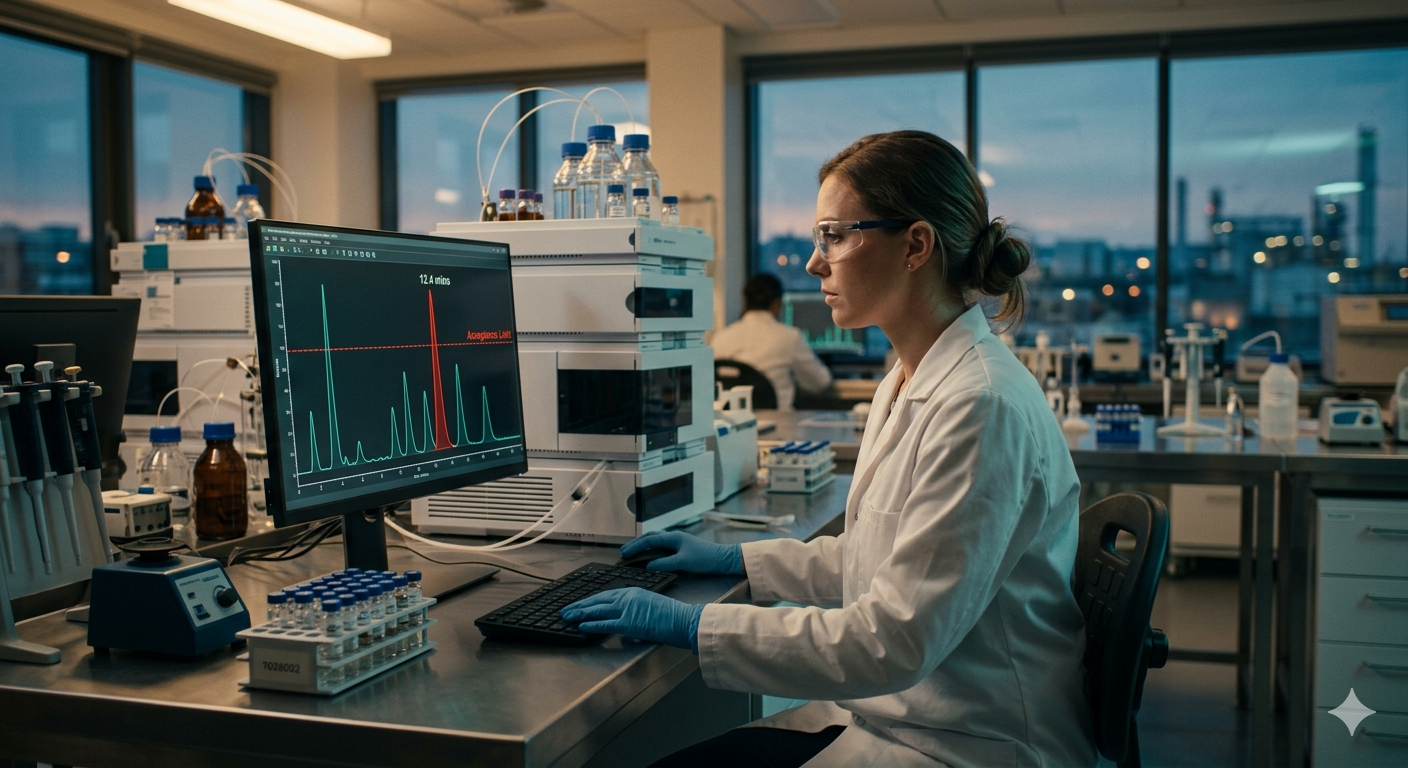
When a quality control result comes back out of specification, the clock starts and the stakes are high. Handle the investigation well and you protect the patient, the batch, and your audit record. Handle it badly — undocumented retests, a "lab error" conclusion with no evidence, a timeline nobody can reconstruct — and you have a data-integrity finding waiting to happen.
This guide gives you the full OOS (out-of-specification) investigation flowchart the way US FDA inspectors expect to see it: a disciplined two-phase process, a defensible root cause, and an audit trail that survives an FDA or MHRA inspection. The flowchart below is the map; the sections that follow walk each decision point.
The US FDA guidance behind the flowchart
The OOS investigation process isn't something each company invents. It comes from two sources every pharma QC lab should know by name:
- US FDA Guidance for Industry: Investigating Out-of-Specification (OOS) Test Results for Pharmaceutical Production (October 2006). This is the document inspectors reference. It defines the two-phase structure, the prohibition on presuming laboratory error, and the rules around retesting, resampling, averaging, and outlier tests.
- The Barr Laboratories ruling (United States v. Barr Laboratories, 1993). This federal court decision is the origin of the Phase I / Phase II framework and the principle that you cannot "test into compliance." The FDA guidance codified what the Barr judgment established.
If your written OOS SOP can't be traced back to these, that's the first gap to close.
The OOS investigation flowchart
  +------------------------------------------------+
  |  OOS result obtained during QC testing          |
  +-----------------------+-------------------------+
                          |
                          v
  +------------------------------------------------+
  |  PHASE I -- LABORATORY INVESTIGATION            |
  |  Analyst + supervisor review BEFORE the         |
  |  original sample is discarded: method,          |
  |  instrument, standards, calculation, raw data.  |
  |  No presumption of laboratory error.            |
  +-----------------------+-------------------------+
                          |
                          v
             Assignable laboratory cause found?
              |                                |
            YES                               NO
              |                                |
              v                                v
  +------------------------+   +-----------------------------+
  | Invalidate result.     |   | PHASE II -- FULL-SCALE       |
  | Document cause + data.  |   | INVESTIGATION               |
  | Report from valid data. |   | IIa: lab phase -- retest /   |
  | Close investigation.    |   | resample per PRE-APPROVED    |
  +------------------------+   | plan                         |
                              | IIb: manufacturing review     |
                              | (process, materials, equip.)  |
                              +--------------+----------------+
                                             |
                                             v
                              Original OOS result confirmed?
                               |                          |
                              NO                          YES
                               |                          |
                               v                          v
                  +--------------------+   +---------------------------+
                  | Invalidate; base   |   | CONFIRMED OOS              |
                  | reportable result  |   | Reject / disposition batch |
                  | on valid data.     |   | Assess impact on OTHER     |
                  +--------------------+   | batches. Raise deviation   |
                                          | -> CAPA. Trend.            |
                                          +---------------------------+
Read top to bottom: every OOS enters Phase I, and the only way out of Phase I without escalating is a documented, assignable laboratory cause. Everything else flows into Phase II, where the result is either confirmed (a real failure) or invalidated on valid data. There is no path on this chart that lets a passing retest quietly overwrite the original result — that omission is deliberate, and it's exactly what an inspector checks for.
What counts as OOS — and how it differs from OOT
An OOS (out-of-specification) result is any test result that falls outside the established acceptance criteria in the registered specification or pharmacopoeia.
An OOT (out-of-trend) result is within specification but inconsistent with the historical pattern — a creeping assay value, a stability data point drifting toward the limit. OOT isn't a failure, but it's an early warning, and a good quality system trends for it rather than waiting for a hard OOS.
Treating these the same is a common mistake. OOS triggers a formal investigation; OOT triggers review and trending. Both need to be captured, but they follow different paths on the chart above.
Phase I — Laboratory investigation
Phase I asks one question: is this result valid, or is there an assignable laboratory cause?
Critically, you may not presume laboratory error. The analyst and supervisor review the method, the instrument, the standards, the sample prep, and the raw data before the original sample is discarded. The investigation must:
- Be initiated promptly (most firms set a 1–3 day target for Phase I).
- Document a clear hypothesis for any suspected lab cause — not "probably a dilution error" but a specific, testable assignable cause.
- Justify any retest before it happens, with a defined retest plan and a record of who authorised it.
If Phase I finds a genuine, documented assignable cause, the result can be invalidated and the investigation closed at this stage. If it does not, the result stands and you escalate to Phase II.
Phase II — Full-scale investigation
Phase II widens the lens beyond the lab. The FDA guidance splits it into two parts:
Phase IIa — additional laboratory work
When Phase I finds no assignable cause but a hypothesis still needs testing, a pre-defined plan may call for:
- Retesting — testing aliquots from the same original sample, only under a documented, scientifically sound plan that was authorised before testing began.
- Resampling — testing a new sample from the batch, justified only when the original sample is shown to be non-representative or compromised (e.g. a documented sampling error), not as a way to dilute a bad result.
Phase IIb — manufacturing investigation
Now the questions are about the batch itself:
- Is the original result confirmed?
- What is the impact on the batch, and on other batches made with the same materials, equipment, or conditions?
- Is there a manufacturing root cause — a process deviation, a raw material issue, an equipment problem?
Phase II is where the OOS connects to the rest of your quality system. A confirmed OOS almost always spawns a deviation and, if a systemic cause is found, a CAPA.
Retest, resample, averaging, outliers — the rules inspectors test
Four practices decide whether your OOS investigation reads as science or as testing-into-compliance:
- Retest — same sample, pre-authorised plan, specific hypothesis. Never "run it again and see."
- Resample — new sample, only with documented justification that the original was unrepresentative.
- Averaging — you may report an average only where the method and specification define it (e.g. content uniformity). You may not average a passing result with the original OOS to make the failure disappear.
- Outlier tests — permitted only where the specification or a validated statistical procedure provides for them, and never for chemical assay results to discard an inconvenient value. An outlier test cannot be used to invalidate an OOS on its own.
Getting any of these wrong is one of the most common roots of an FDA 483 or warning letter on OOS.
Decision and disposition
The investigation closes with a documented conclusion and a batch disposition:
- Invalidated result (assignable cause found) — the original result is set aside with full justification, and the reportable result is based on valid data.
- Confirmed OOS — the result is real. The batch is rejected or dispositioned per procedure, impact on related batches is assessed, and the failure feeds CAPA and trending.
Either way, the decision is made by quality, signed off at the right level, and recorded with the evidence behind it.
Timelines
Most firms target Phase I within 1–3 days and the full investigation within 30 days. The FDA guidance doesn't fix a single number — but whatever your SOP commits to, you must meet it, and an overdue investigation that nobody flagged is itself a finding. A process that tracks elapsed time per stage makes that visible before it bites.
Why spreadsheets and paper fail OOS investigations
OOS is one of the hardest processes to run on paper or email, because the things inspectors scrutinise are exactly the things ad-hoc tools don't capture:
- Timelines. When was the OOS detected? When did Phase I start and close? A paper form doesn't timestamp itself.
- Sequence and authorisation. Was the retest authorised before it ran, or justified after the fact? A spreadsheet can be back-dated; a controlled workflow can't.
- Sign-offs. Who reviewed Phase I? Who approved the disposition? Initials in a margin aren't an audit trail.
- Linkage. A confirmed OOS should be tied to its deviation, its CAPA, and the batch record. In a spreadsheet, those live in four different files.
How to run this flowchart as a compliant workflow in Flobri
Flobri turns the flowchart above into a controlled, stage-based workflow — the same structure used by pharma manufacturers running quality on the platform:
- Status fields and stages move each OOS from initiated → Phase I → Phase IIa → Phase IIb → disposition → closed, so the state of every investigation is unambiguous and visible.
- Stage approvals mean a retest or a final disposition can't proceed without the right person signing off — and every transition is captured with who, what, and when.
- A built-in audit trail records the full timeline automatically. There's nothing to back-date, because the system stamped it.
- Linked records connect each OOS to its deviation, CAPA, batch release, and instrument, so the whole story sits in one place.
- OOT trending surfaces results drifting toward the limit before they become a hard OOS.
The result is an OOS process that closes faster and stands up to inspection — because the discipline of the flowchart is built into the workflow instead of relying on people to remember it.
Frequently Asked Questions
What is the US FDA OOS guidance?
It is the FDA's Guidance for Industry: Investigating Out-of-Specification (OOS) Test Results for Pharmaceutical Production (October 2006). It defines the two-phase investigation, prohibits presuming laboratory error, and sets the rules for retesting, resampling, averaging, and outlier tests. It builds on the 1993 Barr Laboratories court ruling.
How long should an OOS investigation take?
Most firms target Phase I within 1–3 days and the full investigation within 30 days, though the right limit is whatever your procedure commits to — and then you must meet it. A workflow that tracks elapsed time per stage makes overdue investigations visible before they become a finding.
Can you retest an OOS sample?
Only with a documented, pre-authorised retest plan tied to a specific assignable-cause hypothesis. Retesting to "get a better number" without that justification is testing into compliance and is a serious data-integrity violation.
What's the difference between retest and resample?
A retest uses the same original sample under a pre-approved plan. A resample uses a new sample from the batch, and is only justified when the original sample is shown to be unrepresentative or compromised — never as a way to dilute a failing result.
What's the difference between OOS and OOT?
OOS is outside specification (a failure that triggers a formal investigation). OOT is within specification but outside the expected trend (an early warning that triggers review and trending).
Does every OOS need a CAPA?
Not automatically. A confirmed OOS with a systemic root cause needs CAPA; an invalidated result with a one-off assignable lab cause may not. The investigation conclusion drives the decision.
Flobri lets pharma manufacturers run OOS, deviation, change control, CAPA, calibration, and batch release as connected, audit-ready workflows — no coding, built around how your quality team already works. See how Flobri handles pharma quality workflows.
Related guides
- Pharmaceutical Quality Management System (QMS): The Complete Guide
- Batch Release, Deviation & OOS Workflow: Data Fields & Status Model (GMP)
- Deviation Management in Pharma: The Complete GMP Guide
- CAPA Process in Pharma — How to Build a Corrective Action Workflow
- Batch Release Documents in Pharma: Complete Checklist & Process